Thursday, October 25, 2012

Cave Swallow don't care

Who cares if it's sandstorm level S winds?  Who cares if you're the most wind-blown bird in North America?  If it's strong S wind that means you fly directly into it, right? Cave Swallow don't care!  Two years ago when we had Berrien's first Cave Swallows it was practically a gale (it was the Declan Smith windstorm whose 50mph gusts knocked over the tower at the ND football practice killing the cameraman).  Last year when Tim had one it was also strong S winds, today, 2 years (and 2 days) from our first 5 birds, 22 birds flew past Tiscornia, all bee-lining south.  We were up on the dune as there were decent numbers of shorebirds and passerines (mostly siskins) moving in front of tomorrow's front including 19 Long-billed Dowitchers that hopped over the pier and had two decent sized groups (first 7 high birds) go past the end of the pier and then 5 birds following a large Horned Lark flock that went past lower by the end.  We moved out to the end and after about 30 minutes a group of 10 materialized on top of us as they whipped past.  We both blasted away.

This is a crop of my best shot, nearly my last one of the tail end of the flock as they got far enough away that the camera focusing on the water sort of had the birds in a similar focal plane.  Unfortunately these are a little over-exposed as I was expecting the birds to be higher with light sky behind them, not dark water.
 
The next pics are montages of individual birds cropped out of multiple images as I panned through the flock.  These 4 birds were in a little sub-group, I cut out each individual to make it easier to evaluate each one.


The next 2 individuals are from 3 later frames.
 
 
Here's the last 4 birds in the flock (3 of which are pictured in the lead photo)
 
 Not surprisingly, Tim's shots are a lot sharper.
 
Finally a group of Long-billed Dowitchers that flew past at first light.  Unlike the swallows, they were a Tiscornia tick for me.
 
 In addition to the 10 birds photographed and 12 other birds were conclusively saw, there were 2 more identically shaped swallows that cut across the pier and were completely backlit.  The first time we had Caves the committee rejected the first 3 that were written up but not photographed and I'm not completely clear on what they did with the 2 that we photographed.  Tim had excellent shots of one of the birds, that one was accepted.  The 2nd one, which admittedly is a crap blur in one of my shots, was accepted on their site but not in North American Birding or the other way around.  Either way the majority were ignored since alpha error (saying something is something when it's not) apparently cannot ever be allowed whereas beta error (saying something is not something when it is) is quite acceptable. 

That also says nothing of the improbability of mis-identifying Rough-winged or Cliff Swallows as Caves and then subsequently photographing Caves an hour later.  In medical trials this idea is that of being prospective, meaning that you have a theory and then instead of applying it backwards to a set of data, you measure how it works going forward to prove that you are not just forcing your theory onto a past set of data.  When it works going forward (i.e. subsequent birds that we identify as Caves that we photograph as Caves) that is strong support of the original theory (of being able to use binoculars and telescopes to identify birds, not just a shotgun, er I mean camera).

Oh and by the way, even if you think it's hard to photograph a swallow, it's actually harder.

Sunday, October 21, 2012

Peregrinations

October is Peregrine month at Tiscornia.  There tend to be a lot of young birds about moving up and down the beach.

This one had one of the fuller crops, the photo only somewhat does it justice.
If it was a better pic it could have led off the post with a caption contest.  The most obvious one would be "Is that a white-throated sparrow in your crop or are you just hapy to see me?"

There've been a few rarities this month, but none on days I've had off.  I ran into this creeper when checking various places a Brant might hide (in this case right next to the river channel).

Here's what Brown looks like when you don't see a Mottled Duck
And yes thank you, I am aware that if looking for a duck you should probably not be looking at the trees.

Sunday, October 14, 2012

Phalaropes at the end of the rainbow

 
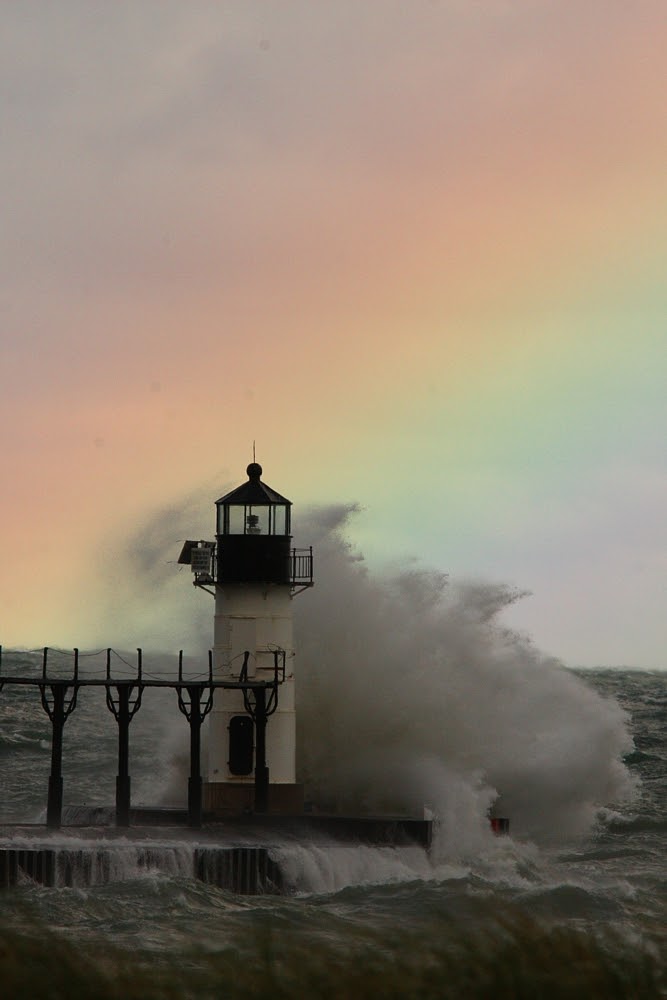
With my computer mostly fixed I can finally edit rainbow pics from a few weeks ago.


It was a pretty blustery day, spray went twice as high as the lighthouse at times.
The sun came out, usually the wave crash pics here are with bigtime overcast skies.

And the long-awaited payoff, a Red-necked phalarope that spent a few minutes on the beach (once the light turned awful again).  Tim had a Red recently at Tiscornia, pretty close to the same time period we had Red Phalaropes off-shore last year.
You can get a sense from its posture that it was getting blown about pretty hard by the wind, in the end it was basically blown away.

Sunday, October 7, 2012

next time it'll be a Rock

The pier can sometimes have an odd mix of passerines falling out on it.  This Marsh Wren was foraging about the equipment and tools on the pier as they took the light out of the red lighthouse.

It had some algae or fishing line wrapped about its feet and once tripped and rolled entirely over as it tried to go down a slanted section of concrete.
It hunkered down in a crevice and extricated itself after about 5 minutes.  It's funny how the lack of a cattail marsh can lead to a much more un-obstructed view.  And if a Marsh Wren will hang out for a couple of hours on the pier then a Rock Wren could totally get us on the 50 Days of Rare scoreboard.

Yellow-rumps are obviously pretty common everywhere now.

We're not the only ones checking out the passerines on the pier.
Both Merlins as well as Peregrines have been hanging out.  A peregrine flew in the other day eating a flicker as it flew.

Finally a harrier that flew down the dunes.
Hopefully I'll be able to get the computer monitor problems I've been having resolved this week, vastly increasing my ability to edit photos and get posts back up.

Saturday, September 15, 2012

Back in the (Western) saddle

They did indeed let me go home last night.  I had planned on mostly relaxing on my couch today, but when Tim found a Western Sandpiper on the pier I couldn't not go after a bird that hasn't been seen in the county since the 90's.

Typically Western is one of the brighter peeps.  This one is a faded adult that's moulted its scapulars to winter gray but retains faded wings and a few black flecks along the flanks retained from breeding plumage.
While some Semipalmated sandpipers do have longish bills, I doubt any are quite as long as this birds.  No Semi has as nice a taper and droop.

A semi also won't have the flank flecks.  White-rumped could have that though it would have wings projecting past the tail, a reddish bill base and would lack the webbing of the toes that Western shares with Semi-palmated.
Dunlin would also lack the semi-palmations, would be a larger bird with an even heavier bill.  With the wings fully flared you can see a little rufous in the central scapulars even in the presumed winter plumage.

The bird mainly hung out with a flock of sanderlings that was moving back and forth between the beach and the piers.

This pic again ties my personal best 4 species in one frame at Tiscornia.  I think the last time I did it was with essentially the same species, just semi instead of Western

I'm now safely back on my couch where I should be able to stay for back to back football triple headers ... unless of course there's something requiring my attention at the pier.  Thanks to Tim for schlepping my scope (stupid 10 pound weight restriction). I was probably looking pretty pitiful shuffling along.

Friday, September 14, 2012

I don't need no stinkin appendix

This would be my inaugural blog from the hospital.  I only manged 2 hours at the lake watch yesterday, woke up feeling like crap but rallied with sotme tylenol and a nap and did get outfor a few hours at midday.  I don't honestly remember if we saw anything, one distant Bairds on the beach maybe.  I didn't get up for it.

Last night felt pain and pressure like I'd never felt before and bit the bullet and went into the hospital.  I don't get NFL network so was going to miss the Bears-Packers game; they do have it at the hospital.  Of course I was in surgery for the 2nd half, not that I missed much, but talk about an expensive ticket to watch a game.  Ah well.

I guess with still having the anesthesia meds and narcotics from yesterday in my system I'm not going to try to make this particularly cohesive.  And I guess I could really ID the stuff as anything and blame it on the drugs.  Tim's seen my ID skillz on no sleep; I could truly be impressive today. 

Anyway, a Philly V from Floral earlier this week


This Red-breasted Nuthatch actually tried to land on my back while I was standing still trying to photograph hummingbirds in the jewelweed with limited success.

Odes are winding down.  This would appear to be an Autumn Meadowhawk based on limited black streaking along the side, some black about the top of the end of the tail.  It was definitely smaller than the average  Ruby Meadowhawk (a few of which are still out).  It also has pale legs and different claspers (hamules?)

Finally a couple skippers, there's been loads of Fiery, European (I think), as well as some Duskies and Indigowings and Checkered-Skippers
Anyway, hopefully my white count comes down this afternoon and they let me go home, keep your fingers crossed.


Thursday, September 6, 2012

Happy 10th, Gull-nasty

The dark-mantled pseudo-kelp hybrid made its annual return to the Lake Michigan shoreline this morning.  It' been an adult since at least 2006 meaning it's at least 10 years old.

Nothing else has its honking bill, rattlesnake-like triangular head and long, long grey-green legs.
As usual it's molting its primaries. Here's the bird in 2011, 2010, 2009 and before.  Last year I emailed Steve Cardiff, one of the LSU researchers who studied the Chandeleur islands Herring-Kelp hybrids.  He said it wasn't one.

I actually have had a ton of good yearbirds in the 2 weeks or so  thanks to considerably expanded UTSJ counts.  A couple different Parasitic Jaegers, Long-tailed Jaeger, Eared Grebe, Whimbrel, Hudsonian Godwit, and Little Gull have all flown past, though most well past photo range.  This Little Gull came close, however it was on top of us before I picked it up and it quickly ducked into the Sun.
Tim immediately started chumming with bread but it never came back.  The closest we came was this young Bonapartes.
It actually has a Black-headed Gull like bit of color at the base of the bill.

For the first few hours today it was super calm.  Tim pointed out the spring peeper like noises in the background which were hundreds of Swainson's thrushes making their way inland high overhead.  As it was pretty calm birds weren't really falling out on the pier though their simple numbers were enough that there was a steady trickle of Palms down the pier.  We had double digit warbler species numbers in the park though the overwhelming majority were Palms.
A Sedge Wren popped out and then took refuge on the escape ladder on the pier's edge before flying off into the grass.
Tiscornia is really the only place I see these birds since they don't ever really seem to tee up for me on their breeding roadsides.