Showing posts with label Peeps. Show all posts

Saturday, August 21, 2021

New Buff Baird's

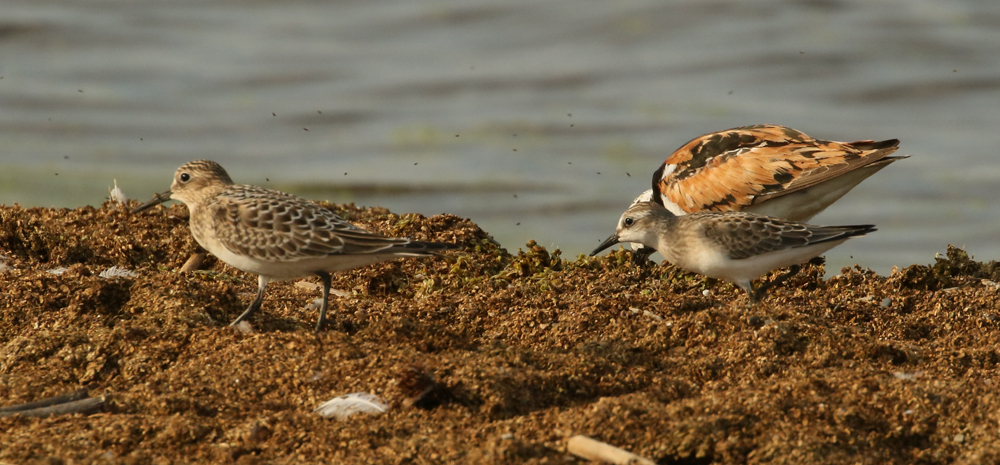
 There's been Baird's Sandpipers in New Buffalo all week, but I didn't go down until this morning when I met with James to bird the beach.  The Baird's didn't disappoint, at one point there were 4 juvies all in view.


There was a juvie Least and Semipalmated Sandpiper loosely associating with the Bairds.  In the above pics you can see wings extending past the tail, the buffy scalloping, and the slightly droopier more tapered bill on the Baird's in comparison with the Semi Sand on the right side of the next pic.

The Turnstone which James spotted as it flew in turned out to be an adult still in pretty full breeding plumage.


Finally a shot of a Killdeer that was so excited to see us (and the eagle) that it teed up pretty nicely

Monday, August 29, 2016

the Buffy peep

After showing pics of Least and Semipalmated Sandpiper the last few posts I graduated up to Baird's Sandpiper this morning on the pier.  I've seen a couple this year but this was the first one that stood more than a few seconds for a pic.

The bird stood out to the naked eye as being buffy and having the scalloped upperparts typical of this species, (the latter especially true in juvies).  A closer look shows the wings extending well past the tail.


I tried a montage of the bird running.
It would be nice if I had greater depth of field; it looks a little off with 2 focal planes in the same image.

Finally an awful photo of the real buff-breasted sandpiper, 3 Buff-breasteds that flew past a few days ago.


Monday, August 22, 2016

Sunrise shorebirds

A young Ruddy Turnstone was at the end of the pier this morning just as the first sunrays touched the pier.


I'm not sure what to make of the gray feather towards the back of the lowermost row of scapulars.  Most shorebirds turn gray in the winter, if this was a dunlin you'd just say there it's one feather down on its way to winter plumage; turnstones don't turn gray though.

There were some peeps on the pier last week, though that day dawned cloudy.
This is a juvie Least Sandpiper
ID points are the neatly tapering slightly drooped bill, warm foxy tones in the upperparts, and white bracing in the scapulars.  Oh, and the pale legs.  When in doubt cheat and just check the legs.

Like this bird.  Pale legs.
Palish.  Whoops.  Better not cheat.  That bird is a very young Semipalmated Sandpiper whose legs aren't as dark as they'll be in a couple more weeks.  Note how its bill doesn't taper as much as the Least's (this bird's bill is on the short side for a Semi btw, again a very young bird).  It has much less intensity of color in the upperparts.

Here's another Semi from that same flock (whose feet at least are also still pretty pale)

Same bird closer.  This one has a little more color in the scapulars than the first bird did, but nowhere near what the Least has.
You can see the semi-palmation of the toes.  (Western Sandpiper has it too).

I had hoped to get close enough to this group to get a good tight shot of the variation of several birds' scapulars, but they woke up and started feeding before I could manage it.

Tuesday, April 28, 2015

Gulf coast Peeps

I'm always surprised by how common Western Sandpiper is in Florida when it's a decidedly uncommon bird in Michigan.

 I suppose I could have titled this post The Early Sandpiper Gets the Worm...

The Westerns were kind enough to be most of the way to breeding plumage, complete with the arrow chevrons going down their flanks.


Here's a different individual.
 They honestly were smaller billed than I remembered them.  I'm not sure if that's a regional difference or if the bills grow over the course of the summer season, or if the birds we've had in Berrien happened to be longer billed because as I look back both the Tiscornia Western Sandpipers of Oct 2013 and of Sept 2012 had longer bills.

This one was still in winter plumage.
I can't tell if it's just the angle making the bill look less tapered and drooped or if this is actually a semi-palmated.
 
Leasts on the other hand certainly had thin tapered bills.

 
I think my memory of Western Sandpiper gets influenced by the much heavier curved bills of Dunlins as well.
Most of the dunlins weren't even this far along in their moult and I didn't take a ton of pics of them.

Tuesday, October 1, 2013

Sayonara September

I didn't have a ton of luck last month, from missing easy shorebirds, unsuccessful chases, and only 50% of my pelagic attempts actually getting offshore.  BUT, it's a new month with new possibilities.  Three golden plovers flew by Tiscornia in the am, though their ID didn't jump out at me at first.  I'd spent a couple hours and then was in the process of leaving to change out a shredded tire on the boat trailer and noticed Tim heading up the beach as I finished a check of the sheltered passerine spots.

We were most of the way to Klock when we started catching up to this bird.
It's a juvenile Western Sandpiper, likely the same one he had 2 days ago on a day I couldn't get out.  It's superficially similar to a Semipalmated but has a longer more tapered and drooped bill, some rufous in the scapulars (though semis can have that), as well as dark anchor markings in the lower scapulars.  The so-called anchors are the dark centers to the lower scapulars that bleed out laterally proximal to the pale edge of the feathers.  Juvenile White-rumped can definitely show this much rufous in the scapulars, but would have longer wings and at this distance a pale reddish base to the lower mandible.  Dunlin is another bird commonly confused with Western Sand, it will have an even longer more drooped bill generally, as well as being bigger bodied in comparison with the Sanderlings.  Last year we had an adult Western Sandpiper transitioning to winter plumage, this bird is marked as a juvenile by having small pale edged wing coverts and scaps.
Westerns are longer-legged than Semi's which means they lean forward more when they feed.  Tim noted that they tend to extend their necks forward as well; it was this behavior that led him to suspect Western on the peep he first saw literally a mile away on Klock from Tiscornia on Sunday.
The bird seemed to prefer looking for the brine flies (?) (midges?) that were washed up at wave's edge, though would follow a group of sanderlings as well that would sometimes forage all the way to the grass practically.  It made a pretty close pass when it flew back out to water's edge at one point, a pic I'm fairly proud of.
No time for auto-focus, you have to just slam it into focus manually.  Admittedly I probably got fairly lucky, but you have to get into Cave Swallow form somehow.

Thursday, September 19, 2013

Poor man's Buff-breasted

I've been hurting for shorebirds this year.  Out of the godwits, avocet, buff-breasted, the 2 reasonably possible phalaropes, red knot, stilt sand, and less common plovers I've seen about half of what I've averaged (frequently with much less effort) in the past.  I still need White-rumped and Purple Sandpiper too but their windows haven't peaked (or even started wrt Purple) yet.

This juvie Baird's was on the beach earlier this week, it's the closest I've come to seeing a Buff-breasted Sandpiper this year.  In the past I've usually either had Buff-breasted on calm sunny days in August or brisk-strong N wind days in September.  The Baird's appeared on a brisk N wind.
 

I may have had a shot at 280 this year with some rarity luck if I'd had an average number of shorebirds, I have virtually no chance at that barring some crazy luck with rarities at this point.

Here it found some micro something or another to eat.
Note the pale scalloping to the scapulars marking this bird as a juvie.  The long wings that extend past the tail eliminate all other peeps except the fairly dissimilar White-rumped.  The bird has a more cleanly cut off buffy breast than does Semi-palmated in addition to a slightly heavier and more drooped bill.
I don't see Baird's in the water very often, this day there was a large puddle on the upper stretch of the beach where it was foraging on a fairly gusty day.

I had hoped to do a pelagic today but the storm and rain put a pretty emphatic crimp on those plans.

Wednesday, August 28, 2013

Baird's and Bonaparte's aren't Sabine's

A Sabine's Gull was seen yesterday for about an hour or so about 5 miles north of the BBC field trip and 10 miles south of where we were sitting on the end of the pier.  It was a muggy day and nothing was moving around.  But, word of the bird didn't get out until the evening, leaving one of my biggest nemesis and most desired birds firmly anchored its status quo.

I walked the section of beach where it was seen yesterday under much different weather conditions, I didn't really expect to see it.  I didn't.  At times the mist and fog were making it really difficult to see and I was about 15 feet from this Baird's before I saw it as it flushed.  Its flight call sounds like a Sanderling giving the call through clenched teeth.  I found the bird a little further up the beach at Tanner's Creek.

The biggest differences between it and Semipalmated Sandpiper (below from Tiscornia today) are structural:  a longer bill, longer neck, and primaries that extend beyond the tail.  They have much more of a scaled look at distance than the Semi's do though you wouldn't know that due to the distance differences between the two pics.
The semi's shape is a little off hunched into a north wind.

The Sabine's was with Bonaparte's.  I saw 4 Bonaparte's along the Warren Dunes - Weko stretch and we had a few yesterday go by Tiscornia.
Above is a juvenile, below an adult from a few days ago.


Friday, April 26, 2013

the easier Baird's bird

There've been a couple Sanderlings hanging around Tiscornia of late.  Today a 2nd shorebird joined one of the Sanderlings, a very similarly sized, somewhat slimmer bird with more narrow wings, as they flew in off the lake.  They circled a few times, it kind of seemed like the Sanderling was harassing the peep in the air somewhat, but they landed and tolerated each other well enough along the shoreline.  I walked down to take pics of the Baird's Sandpiper.

I don't think adult Baird's Sandpiper occurs at a different rate from adult Baird's Sandpiper in fall, but the juvenile Baird's are a lot more prone to either coming farther east or else stopping a lot more since as a species they're certainly easier in the fall.  The adults are less scaled than the juveniles, but they're still a buffier bird than the other peeps.  The scapulars extend past the tail which helps rule out the more common Semi-palmated.

The bird's slightly in front of the Sanderling, but you can tell they're similarly sized.  The size is the other thing that makes it a lot easier to eliminate Semi-palmated.

I've made a couple circuits of Floral in the last few days.  Ruby-crowned's are always fun when they show their ruby.
 
 
I feel like gnatcatchers have been a little more common than some years (though maybe it's just that a lot of stuff is delayed).
 
Finally a Broad-winged from earlier today.  I have some thoughts about hawk migration in Berrien and occurrence of some of the Western birds that I'm going to hold for another post.
 

Saturday, September 15, 2012

Back in the (Western) saddle

They did indeed let me go home last night.  I had planned on mostly relaxing on my couch today, but when Tim found a Western Sandpiper on the pier I couldn't not go after a bird that hasn't been seen in the county since the 90's.

Typically Western is one of the brighter peeps.  This one is a faded adult that's moulted its scapulars to winter gray but retains faded wings and a few black flecks along the flanks retained from breeding plumage.
While some Semipalmated sandpipers do have longish bills, I doubt any are quite as long as this birds.  No Semi has as nice a taper and droop.

A semi also won't have the flank flecks.  White-rumped could have that though it would have wings projecting past the tail, a reddish bill base and would lack the webbing of the toes that Western shares with Semi-palmated.
Dunlin would also lack the semi-palmations, would be a larger bird with an even heavier bill.  With the wings fully flared you can see a little rufous in the central scapulars even in the presumed winter plumage.

The bird mainly hung out with a flock of sanderlings that was moving back and forth between the beach and the piers.

This pic again ties my personal best 4 species in one frame at Tiscornia.  I think the last time I did it was with essentially the same species, just semi instead of Western

I'm now safely back on my couch where I should be able to stay for back to back football triple headers ... unless of course there's something requiring my attention at the pier.  Thanks to Tim for schlepping my scope (stupid 10 pound weight restriction). I was probably looking pretty pitiful shuffling along.

Monday, August 20, 2012

Peep show

Peeps continue to trickle through along the beach.  Baird's Sandpipers have arrived on schedule (though last year I saw only one the entire fall).  I've seen Baird's about a third of the time on about 30 visits to Tiscornia in the 2nd half of August over the years.
While buffy juvenile Semipalmated's do exist, they don't approach the overall buffiness of the entire head and breast of a fresh juvenile Baird's.  The scaliness and long primary projection also help the ID.
Here's another semi for comparison:
It has a shorter bill, primaries that stop at the end of the tail and less overall scaliness.

There was an adult Semi, I think the first one I've seen recently.
It's still in mostly worn breeding plumage with old wing coverts and a lot of worn scapulars, though there're a few gray winter scapulars starting to fill in.

An adult Semi Plover was in similar condition,
a lot of worn wing coverts, but brighter legs and bill base than the fresh juvenile...