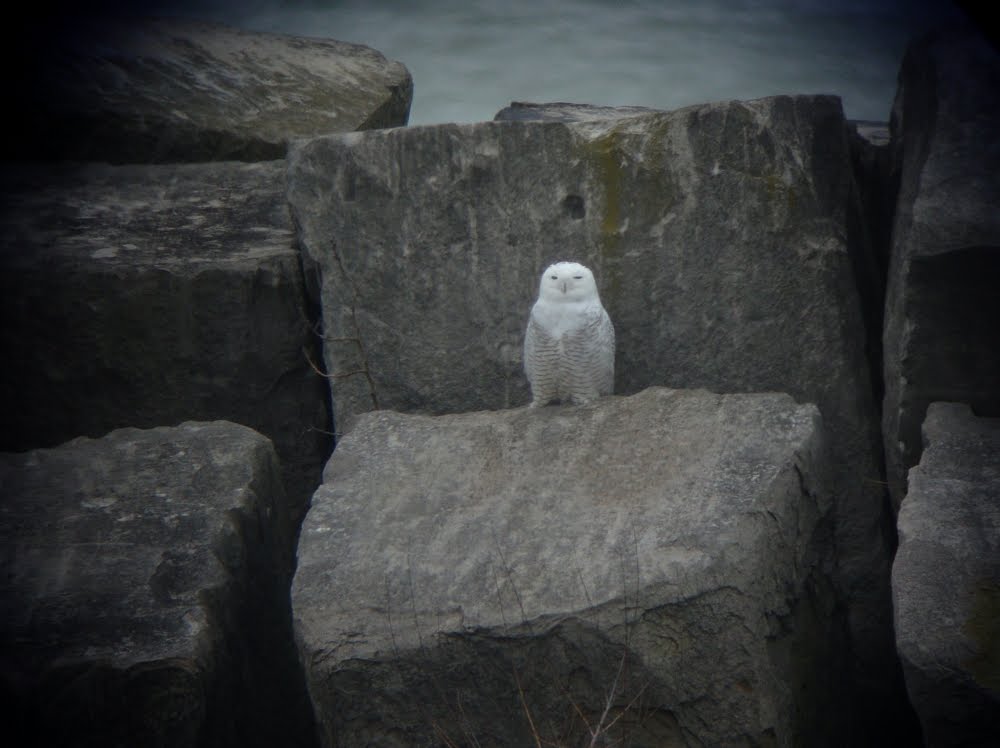
Mike Bourdon found a Snowy at New Buff this morning so Hazel and I drove down to take a look. It was still there, teed up in front of a post that the waves and wind had driven into the breakwall
It surveyed the harbor, perhaps wondering if Scaup could be on the Thanksgiving leftovers list.
I've been struggling this month to find the time to get out and find some photo targets, but the best two shots this month are a (mostly obscured) Barred Owl and a bright Red-shouldered Hawk
Showing posts with label Birding with the girls. Show all posts
Friday, November 29, 2019
Saturday, August 12, 2017
Grouse and leps on Mt Washburn
Most of the Dusky Grouse I've seen in my life have been along this trail.
The scattered stands of trees that extended up some of the sheltered gullies held some concentrations of other western songbirds, first a female Cassin's Finch,
As well as some little flocks that were mostly young Audubon's Warblers mixed with Mountain Chickadees.
Really though the alpine wildflowers (and butterflies that went along with them were the highlight of this trail).
This is Colorado Alpine, a butterfly only found above the treeline in the central Rockies:
Milbert's Tortoiseshell gets my vote for most impressive North American lep. It can be found in Michigan but I've only seen it in the Rockies.
This is Phoebus Parnassian, my first parnassian of any kind.
Fritillaries are pretty common out west. I think the first one is Callippe and the second is Zerene, but both could be wrong.
Painted Lady can be certainly be found in Michigan, but not usually in a bed of lupine.
Finally on the butterfly front I think this is Christina's Sulphur (though the pics of the underwing are more important from an ID standpoint)
A couple other pics that don't even have butterflies on them...
If you want a sense of scale of the place, the fire station is the little blurry dot on the highest point to the left of Ginger's shoulder...
Saturday, June 18, 2016
a ten-year-old Hazelnut
Hazel, my oldest kid, turned 10 earlier this week.
She likes to release the dragonflies she catches off her nose if you can believe that.
My brother sent her the coolest legos I've ever seen, can you ID the birds?
Left to right it's a Eurasian robin, Green Violet-ear, and Blue Jay.
Here with Hannah...
Finally a Spatterdock Darner, the first one I've caught in a few years.
Some of the Darners will bite; I didn't let her go nose-to-frons with this creature.
She likes to release the dragonflies she catches off her nose if you can believe that.
My brother sent her the coolest legos I've ever seen, can you ID the birds?
Left to right it's a Eurasian robin, Green Violet-ear, and Blue Jay.
Here with Hannah...
Here she's holding a Unicorn Clubtail.
It's very similar to Lilypad Clubtail. Both have very narrow S3 and S4 side stripes (the vertical stripes on the body under the front wing), but Unicorn has a lot more yellow at the very end of the abdomen (tail).Finally a Spatterdock Darner, the first one I've caught in a few years.
Some of the Darners will bite; I didn't let her go nose-to-frons with this creature.
Thursday, September 4, 2014
Virginia Beach Odes
Part of the reason I got out so little in August was that a lot of my days off were concentrated in a week where we drove out to Virginia to visit Ginger's brother and family and then mine and family on the way back. Each time we go there I try for Seaside Sparrow. I found a Cottonmouth at Back Bay NWR, but no sparrows. There were dragonflies though.
This is Needham's Skimmer. It felt very similar to Golden-winged Skimmer in terms of shape and wing coloration.
I had actually netted one to take a closer look at it when a fully armed conservation officer told me I was harassing the wildlife. I pointed out to him that I'd squished 3 deerflies too.
This is Four-spotted Pennant ...
... and this one Seaside Dragonlet.
The other lifer Ode for me on the trip was Bar-winged Skimmer, which was actually pretty common in Brent's backyard. It's very similar to Slaty Skimmer, though a touch larger and just as hard to catch. This is male and female.
Here's Hazel and cousin Ellie (who netted a few Amberwings)
This is Needham's Skimmer. It felt very similar to Golden-winged Skimmer in terms of shape and wing coloration.
I had actually netted one to take a closer look at it when a fully armed conservation officer told me I was harassing the wildlife. I pointed out to him that I'd squished 3 deerflies too.
This is Four-spotted Pennant ...
... and this one Seaside Dragonlet.
The other lifer Ode for me on the trip was Bar-winged Skimmer, which was actually pretty common in Brent's backyard. It's very similar to Slaty Skimmer, though a touch larger and just as hard to catch. This is male and female.
Here's Hazel and cousin Ellie (who netted a few Amberwings)
Wednesday, August 13, 2014
August darners
Work schedule's been incredibly dense of late and I've barely gotten out. Last week I went with the kids to Sarett prairie to see what odes were about. There've been darners in some of the corners at times during the summer and apparently this is the time of year they're most prominent.
Fairly quickly we found some largish colorful ones, though they evaded the net for a firm ID. Hazel spotted where one landed after I swung at it and I took a few pics of the out-of-reach ode.
I think that based on the pattern of striping on the sides that it's a Green-striped Darner, though Canada Darner is very similar. It'd be nice to see one in the hand to be certain. [See comment below about why it's probably neither of those, but Lance-tipped instead].
Next is a Fawn Darner, an ode that's fairly widely distributed in Michigan but that I'd never encountered before.
It remained on the twig we set it on when we let it go long enough for a few more pics.
Finally Hazel with a meadowhawk. Both girls think it's high humor to release them from their noses.
Fairly quickly we found some largish colorful ones, though they evaded the net for a firm ID. Hazel spotted where one landed after I swung at it and I took a few pics of the out-of-reach ode.
I think that based on the pattern of striping on the sides that it's a Green-striped Darner, though Canada Darner is very similar. It'd be nice to see one in the hand to be certain. [See comment below about why it's probably neither of those, but Lance-tipped instead].
Next is a Fawn Darner, an ode that's fairly widely distributed in Michigan but that I'd never encountered before.
It remained on the twig we set it on when we let it go long enough for a few more pics.
Finally Hazel with a meadowhawk. Both girls think it's high humor to release them from their noses.
Sunday, June 17, 2012
"A bird surprise."
The kids were very happy when I got home from work today so they could give me the Father's Day present they created:
Hazel (now 6) said it was my Bird surprise. Hannah will turn 5 next month.
Here's a close-up. Hazel said it's a Robin with a beard:
Hazel (now 6) said it was my Bird surprise. Hannah will turn 5 next month.
Here's a close-up. Hazel said it's a Robin with a beard:
Tuesday, December 6, 2011
the right white birds
Year birds at last; after about a 3 week lull where I couldn't add anything new, yesterday turned things around. Tim found a Snowy Owl at New Buffalo which was good enough to stick around for me.

Here you can see the bird over Hannah's left shoulder on the far breakwall. She enjoyed the "Castle," i.e. the big granite blocks that should help make her more likely to be enthused for future Purple Sandpiper/Harlequin Duck searches.
Iceland Gull is the last "easy" bird that I was still missing and as it happens we had two of them yesterday. First, an adult at New Buffalo
While at rest it conceivably could be blown off as a Herring Gull, in flight the vastly reduced primary coloration is a lot more apparent. I forget what percentage of Iceland gulls have somewhat dark eyes, but certainly the paleness of the primaries is well outside of Thayer's range.
Here's a juvenile that flew past Tiscornia in the morning (and landed briefly on the beach). As compared with the juvenile Thayer's gull, it's paler overall without the darker secondaries.
Iceland Gull is the last "easy" bird that I was still missing and as it happens we had two of them yesterday. First, an adult at New Buffalo
While at rest it conceivably could be blown off as a Herring Gull, in flight the vastly reduced primary coloration is a lot more apparent. I forget what percentage of Iceland gulls have somewhat dark eyes, but certainly the paleness of the primaries is well outside of Thayer's range.
Here's a juvenile that flew past Tiscornia in the morning (and landed briefly on the beach). As compared with the juvenile Thayer's gull, it's paler overall without the darker secondaries.Sunday, February 27, 2011
Birding Disney
Well, the annual February conference is in Orlando this year so the kids are getting their first Disney experience. I didn't run into a ton of birds, (no Daffy Duck doesn't count), but the ones that are around are pretty tame. Like forget-head-and-shoulders-let's-try-ibis-iridology tame.
I'm not used to having plenty of light and am a little rusty in terms of rapidly adjusting camera settings to not blow out whites, etc...
The first cycle birds are easier subjects with less bright bright white.
I'm not used to having plenty of light and am a little rusty in terms of rapidly adjusting camera settings to not blow out whites, etc...
The first cycle birds are easier subjects with less bright bright white.Friday, December 17, 2010
Cooper Socks
It was a black-and-white theme at Tiscornia this morning with both a drake Long-tailed Duck and the Western Grebe appearing at the end of the pier. The grebe didn't stay long. Up the beach a Glaucous Gull joined a Great Black-backed. The two heavyweights hung out somewhat, re-settling within feet of each other when the flock circled farther up the beach.


Some Great Black-backed's can have fairly dark eyes, vaguely recalling Western Gull. Just for the sake of argument, Western would typically show a very heavy gony angle, and less of a white tip at the ends of P9 and P10.
In the afternoon the kids didn't want to take a nap so I took them out to look for shrikes expecting them to quickly fall asleep in the back seats. As anyone who has gone looking for shrikes could predict, I didn't find one. I did however find this Red-shouldered Hawk.
Some Juncos and Tree Sparrows were flying out of the little thicket which brought questions from Hazel and I explained that the little birds were probably worried that it was a Cooper's Hawk. Hazel then asked what a Cooper Sock was. This led to about 10 minutes of high comedy for the girls as they decided they were wearing Cooper's and Red-shouldered Socks.


Some Great Black-backed's can have fairly dark eyes, vaguely recalling Western Gull. Just for the sake of argument, Western would typically show a very heavy gony angle, and less of a white tip at the ends of P9 and P10.In the afternoon the kids didn't want to take a nap so I took them out to look for shrikes expecting them to quickly fall asleep in the back seats. As anyone who has gone looking for shrikes could predict, I didn't find one. I did however find this Red-shouldered Hawk.
Some Juncos and Tree Sparrows were flying out of the little thicket which brought questions from Hazel and I explained that the little birds were probably worried that it was a Cooper's Hawk. Hazel then asked what a Cooper Sock was. This led to about 10 minutes of high comedy for the girls as they decided they were wearing Cooper's and Red-shouldered Socks.
Subscribe to:
Posts (Atom)