Sunday, December 2, 2012

The one day pelagic season

For a number of reasons yesterday was the first time this year we got out on the boat.  I'm guessing that it was the last day this year we got out on the boat.  The big loon flock that stages some years off Lakeside seemed to have moved on, we only saw the winter resident Red-throats.  We were able to chum in good numbers of gulls which would frequently move past inside of comfortable camera range.  There wasn't a ton of diversity of species, but there were a handful of Thayer's class birds over the day.

This juvenile stopped by briefly and landed quite backlit so I only had a handful of shots at it.
The prominent secondary bar and the longish bill probably elminates Iceland fairly easily.

Next is a 3rd winter bird.
A couple of flight views:
I think the tail is too dark to be an Iceland.  In adults Kumlien's Iceland is said not to have subterminal markings on P5 which this bird has.  About 90-95% of my 2nd and 3rd year Herring gulls shots have light eyes, Iceland usually has light eyes so the dark eyes are supportive of Thayers; I don't know how fast Iceland typically gets light eyes though.  P9 has dark along the entire leading edge which in adults is very good evidence for pure Thayer's.  The bill does have some pinkish tones which Olsen and Larsson note in Thayer's; Iceland at this age trends more towards greenish tones to the yellow.
I like this next shot mainly for the way the wings are catching the air; you can get a sense of the curvature that gives them lift.

Finally an adult bird...
Its eye is on the light end of the spectrum for Thayers (Howell and Dunn describe it as dirty yellowish to dark).  It's heavily hooded as in Thayer's.  The wing pattern with a tiny fleck on P5, and a very very narrow black leading edge to P9, and very little subterminal black on P10 is a little borderline.  Howell and Dunn show this pattern for Thayers-Kumlein intergrade in one of their (borrowed) plates, Olsen and Larsson would seem to put this wing pattern more solidly in the Thayer's camp based on their spreadwing plate.

Other pics I've posted ... adult Thayers Gull (also from boat last year), and a Thayer's type.

And coming soon to a blog near you, (drumroll please), a different dark-mantled hybird!!!

Tuesday, November 20, 2012

the Bluebird-Thrush

I've been studying the Costa Rica book a lot and trying to puzzle out all the hyphenated combination names (e.g. Antwren, antshrike, shrike-vireo, shrike-tanager) and it seems like if Townsend's Solitaire had been named under similar conventions it would be Bluebird-thrush.  Yes I know that bluebirds are technically thrushes.  I chased the Solitaire that Kip had found at Warren Dunes.  Brad pointed me in the right direction (a cedar stand I know they and Tim have been checking for years) and I didn't have to wait long for the bird to fly in.  When I saw it flash through the bins my first impression was of a really brown mockingbird as a bird with a long tail with light edges flew away around a tree and perched out of sight.  I had almost convinced myself I had somehow gripped a junco when it flew back.
After somehow not being found in the history of the county, 3 or 4 have been found in the last week.  Today was the first chance I'd had to see the Sun in about 4 days so I was glad one stuck around.
It tended to perch very still and quietly on deciduous snags, or else forage very actively and mostly concealed in a berry-laden juniper.
The heavy overcast made photography fairly difficult.  I may go back if there's a nice day in the next few.
As someone who doesn't go the UP very often, the only other time I've seen this bird in Michigan was a Livingston Co bird that I'm guessing was a lot of SE Michigan birders' state lifer from back in the digi-scoping days.
This was only my 4th county lifer this year; the last 2 years have scored 7 and 6 respectively, either I'm starting to reach a threshold of dimishing returns or I'm due for hopefully one more this year.

Friday, November 16, 2012

Not all Rednecks make moonshine

This Red-necked Grebe has been hanging out along the pier apparently for the better part of a week or so.  You can just see the white leading edge to the inner upper wing that can be a helpful mark in flight.
 
I walked down to get shots of it next to the pier once it came in to eat gobies with the local Horned Grebes...
I bet goby-belch is nasty.  I'd never heard a Red-necked vocalize before; this one was giving what sounded to me like blackbird-like chack calls, very different from the gull-like calls of the Horned Grebes.
Here's a comparison shot with one of the Thumb Alcids.

A few Black Scotors have been hanging out as well, though their quarry is zebra or quagga mussels.

Finally a couple terrible record shots of a Bohemian Waxwing flock I chanced upon at Floral.  I'd only seen them twice before and never in these kind of numbers.
Unfortunately they flew pretty quickly, other birds flew up from other trees.  I couldn't get a shot with the entire flock, but there's about 75 sets of rufous undertail coverts in this shot.
A much closer shot of a flying-away Bohemian might make a decent photo quiz.

Monday, November 12, 2012

maybe Jaegers taste the same too.

You may remember my father-in-law from perseverative posts regarding goose subspecies.  An avid outdoorsman, he told me, in tongue-in-cheek fashion, that they all tasted the same. 


Horst (here with Hazel about 5 years ago (he was good at avoiding the camera)) passed away last week,;today was the first day in about a week therefore that I'd birded the lakeshore.  It was pretty decent.  In the midst of a good waterfowl movement a jaeger flew into my scope.  The bird flew hard after a gull, cut inland, and then headed back out to sea.  We ran down to the lower lip of the dune but it kept moving out so pics became quite distant.

Pomarine Jaeger is one of the most frequently rejected birds but the shape and proportions of the bird, heaviest in the breast rather than the pot-belly of a parasitic, and the wide wing base with a relatively short hand are evidence for it. 

Most of the shots are fairly wing-on, though the bird banks somewhat in the 3rd from the right still, showing the paler, barred (through the scope) rump that's paler than the nape.


Bufflehead were the other remarkable bird today, usually a flock of a dozen is a decent number, today groups of 30-50 were routine.  Here's an average sized one.
I've got to work the next few days, hopefully this is a year when the November 14th bird sticks around (like the murrelet, not the black-headed gull).

Thursday, October 25, 2012

Cave Swallow don't care

Who cares if it's sandstorm level S winds?  Who cares if you're the most wind-blown bird in North America?  If it's strong S wind that means you fly directly into it, right? Cave Swallow don't care!  Two years ago when we had Berrien's first Cave Swallows it was practically a gale (it was the Declan Smith windstorm whose 50mph gusts knocked over the tower at the ND football practice killing the cameraman).  Last year when Tim had one it was also strong S winds, today, 2 years (and 2 days) from our first 5 birds, 22 birds flew past Tiscornia, all bee-lining south.  We were up on the dune as there were decent numbers of shorebirds and passerines (mostly siskins) moving in front of tomorrow's front including 19 Long-billed Dowitchers that hopped over the pier and had two decent sized groups (first 7 high birds) go past the end of the pier and then 5 birds following a large Horned Lark flock that went past lower by the end.  We moved out to the end and after about 30 minutes a group of 10 materialized on top of us as they whipped past.  We both blasted away.

This is a crop of my best shot, nearly my last one of the tail end of the flock as they got far enough away that the camera focusing on the water sort of had the birds in a similar focal plane.  Unfortunately these are a little over-exposed as I was expecting the birds to be higher with light sky behind them, not dark water.
 
The next pics are montages of individual birds cropped out of multiple images as I panned through the flock.  These 4 birds were in a little sub-group, I cut out each individual to make it easier to evaluate each one.


The next 2 individuals are from 3 later frames.
 
 
Here's the last 4 birds in the flock (3 of which are pictured in the lead photo)
 
 Not surprisingly, Tim's shots are a lot sharper.
 
Finally a group of Long-billed Dowitchers that flew past at first light.  Unlike the swallows, they were a Tiscornia tick for me.
 
 In addition to the 10 birds photographed and 12 other birds were conclusively saw, there were 2 more identically shaped swallows that cut across the pier and were completely backlit.  The first time we had Caves the committee rejected the first 3 that were written up but not photographed and I'm not completely clear on what they did with the 2 that we photographed.  Tim had excellent shots of one of the birds, that one was accepted.  The 2nd one, which admittedly is a crap blur in one of my shots, was accepted on their site but not in North American Birding or the other way around.  Either way the majority were ignored since alpha error (saying something is something when it's not) apparently cannot ever be allowed whereas beta error (saying something is not something when it is) is quite acceptable. 

That also says nothing of the improbability of mis-identifying Rough-winged or Cliff Swallows as Caves and then subsequently photographing Caves an hour later.  In medical trials this idea is that of being prospective, meaning that you have a theory and then instead of applying it backwards to a set of data, you measure how it works going forward to prove that you are not just forcing your theory onto a past set of data.  When it works going forward (i.e. subsequent birds that we identify as Caves that we photograph as Caves) that is strong support of the original theory (of being able to use binoculars and telescopes to identify birds, not just a shotgun, er I mean camera).

Oh and by the way, even if you think it's hard to photograph a swallow, it's actually harder.

Sunday, October 21, 2012

Peregrinations

October is Peregrine month at Tiscornia.  There tend to be a lot of young birds about moving up and down the beach.

This one had one of the fuller crops, the photo only somewhat does it justice.
If it was a better pic it could have led off the post with a caption contest.  The most obvious one would be "Is that a white-throated sparrow in your crop or are you just hapy to see me?"

There've been a few rarities this month, but none on days I've had off.  I ran into this creeper when checking various places a Brant might hide (in this case right next to the river channel).

Here's what Brown looks like when you don't see a Mottled Duck
And yes thank you, I am aware that if looking for a duck you should probably not be looking at the trees.

Sunday, October 14, 2012

Phalaropes at the end of the rainbow

 
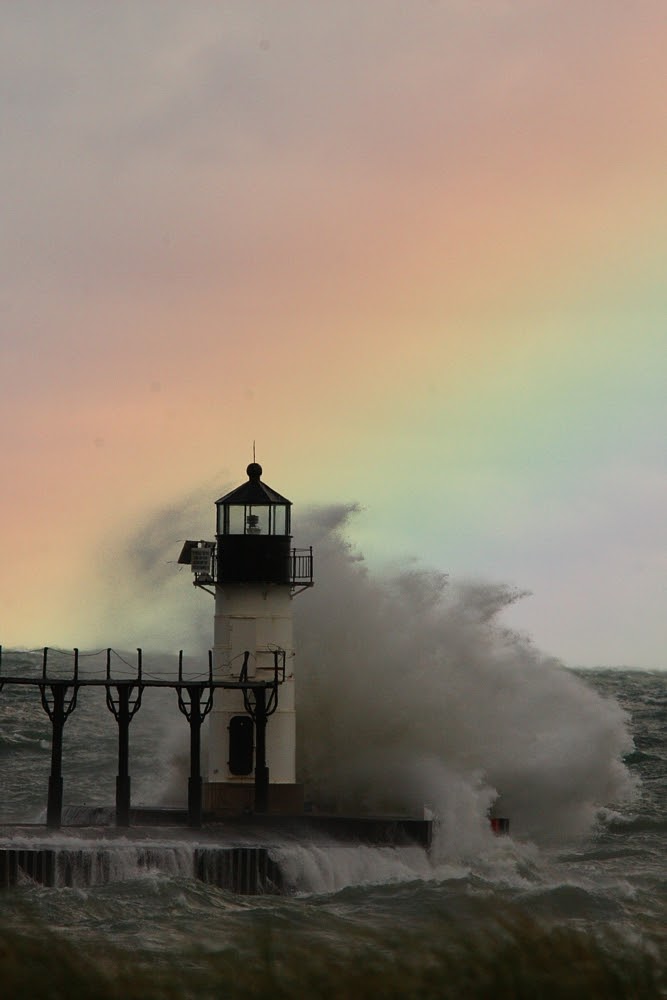
With my computer mostly fixed I can finally edit rainbow pics from a few weeks ago.


It was a pretty blustery day, spray went twice as high as the lighthouse at times.
The sun came out, usually the wave crash pics here are with bigtime overcast skies.

And the long-awaited payoff, a Red-necked phalarope that spent a few minutes on the beach (once the light turned awful again).  Tim had a Red recently at Tiscornia, pretty close to the same time period we had Red Phalaropes off-shore last year.
You can get a sense from its posture that it was getting blown about pretty hard by the wind, in the end it was basically blown away.