Thursday, April 9, 2015

the Baddest Shorebird

I'd never seen an Oystercatcher up close before.  They were much bigger than I expected.  Per Sibley heavier than Little Blue or Tricolored Heron, twice as heavy as a teal and a couple ounces bigger than a Wood Duck.


Here it is compared to a Sanderling

A Western gets too close for comfort...

They had a couple different feeding styles, sometimes getting low and probing forward,

at other times sewing like a dowitcher...


They two birds wandered around, I couldn't really get a sense of what they liked to feed in the best, they seemed equally interested in the exposed beach and the last of the tidewater.


Eventually they took flight and moved 30 yards down the beach.

Tuesday, April 7, 2015

shorebird reflection shots

Bunche Beach in Fort Myers was a really great place to take pics in the early morning light (what will be a recurring theme over the next 2 weeks).  This is a collection of shorebirds-and-their-reflection.  Most are just starting to get some breeding plumage coming it but are still mostly in their winter drab.


 I'm always surprised by the prehensile billtips of dowitchers (a short-billed in this case)

Dunlins were one of the most common birds and one that I didn't take a ton of pics of

Western Sandpiper on the other hand ...
 I couldn't get over how many Westerns there were along the gulf.  I'm not sure if they were wintering or just stopping over in a leg of their migration. 

I'm going to do an entire post probably on the peeps, I'll stick with these Leasts for now.

I've read that a simple evaluation of whether there's decent light for photography is that your shadow should be longer than you are.  I'm not sure what it says that the Least Sandpipers' shadows were nearly longer than I am

Wilson's Plover wasn't super common but was present most of the mornings.  I kept blowing them off as Semi-palmated's when I'd look with the naked eye since they fell into the brain's search image of "small, brown, one band, bright legs" and nearly filtered them entirely more than once.

no problems with Ruddy Turnstone, nothing else has their bill and legs.

Saturday, April 4, 2015

The mad linebacker of the flats

... is someone's description of Reddish Egret.  I was thinking it was Peterson, but that phrase isn't in his guide when I checked just now.  I'm thinking it's probably somewhere in a Pete Dunne essay.

Reddish Egret has a very narrow range in the U.S., I hadn't really realized how restricted their habitat is, but didn't have any decent pics of the species before this trip.  On our first evening we went to a beach a mile from the motel and I spotted one up the beach.  It didn't take long to walk over to it.

 I don't usually center the subject in the exact middle of the frame, but I liked the symmetry that the dunlins randomly configured themselves into.  I walked out into the gulf for a better angle at the bird.

I was back at the beach at absolute first light the next morning and there were a few more feeding, staggering about the tidal pools.  Peterson's description alluded to their drunken feeding habits.


In a first for the blog I made a gif of one of them careening about the pool

There was an immature in the same area, the rich morning light gives it credit for much more color than these very dull bird typically display.


A final view of one of the adults in flight.

Friday, April 3, 2015

Forget the appetizer

Don't get me wrong, I like April migrants as well as the next person.  Birds like Fox Sparrow, Hermit Thrush, and Yellow-bellied Sapsucker all herald the May migration that is to come.  That being said, they're the appetizer that leaves you hungry for the main course - the bulk of the passerine migrants, especially the warblers to most birders.  (We'll leave dessert, the vagrants, for another few weeks). 

We took the kids to Florida for spring break for a little less than a week allowing me to skip right to the warblers.  The really fun thing was that while the 1st, 2nd, and 3rd most common warbler here at the end of the month will be Yellow-rumped  (followed by Nashville and Black-throated Green and their ilk), the warblers (with the exception of the wintering Palms) were fairly different along the Gulf coast.

The most common migrant I found was Hooded Warbler.
 
They seemed to forage much lower than they usually sing on territory around here.


The next most common was Northern Parula of all things.
 The females especially seemed to like foraging in an unfamiliar fruiting tree that was attracting a lot of small insects.
 I'd never heard the bill snap of a warbler capturing a gnat, but it was a sound a person could get used to.  When we hiked at inland spots (most of these pics are taking by the Ybel lighthouse on Sanibel) the male parulas seemed to be on territory.  This next bird was the only one I actually saw.

Prothonotary was also pleasantly common.


I think this last one has a piece of fruit that dropped off the tree in its bill.  It dropped it after a few seconds.

I've never spent a lot of time at true migrant traps, but this one 5 miles and a tollbridge away from the motel was well worth it.  While the above 3 species accounted for the majority of species there were a few others about.  I glimpsed Worm-eating twice, missed Swainson's by an hour, but did get nice pics of what appeared to be a migrant Yellow-throated.
 I maneuvered a little closer but was shooting through some leaves.

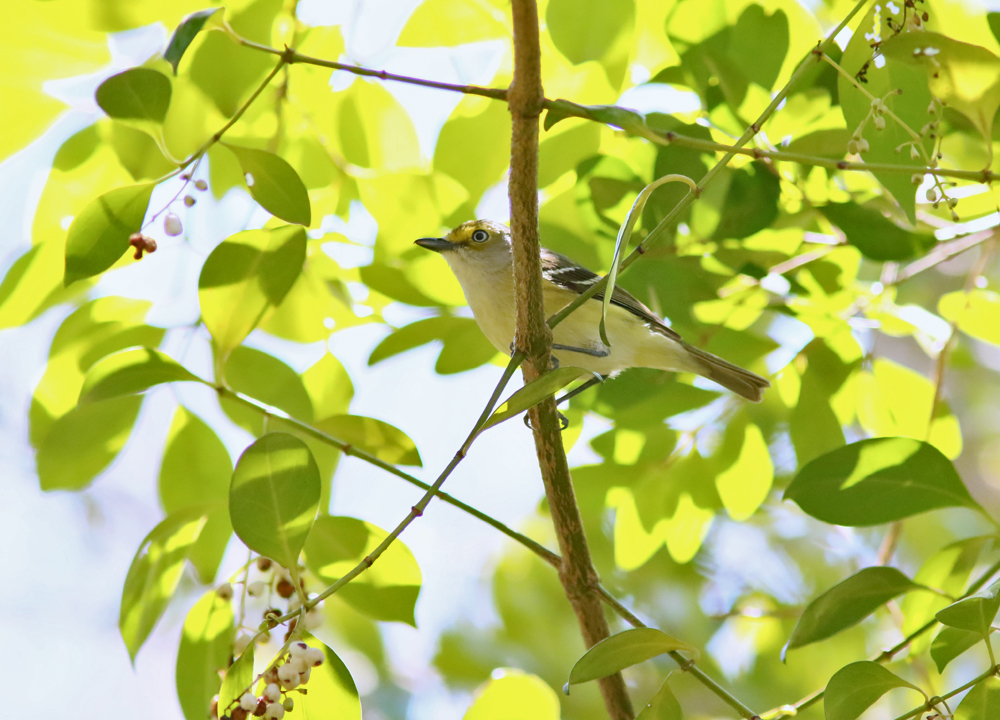
White-eyed Vireo wasn't really a migrant; they were singing on territory in a lot of spots.

Wednesday, April 1, 2015

The emblem and the runner-up

You'd think after a month and a half of writing about Costa Rica I'd have a backlog of topics for Berrien.  I have a few pics of a Thayer's Iceland integrade and some pics of a Glaucous Gull with landfill trash ... but nah.  Speaking of the landfill this eagle was there too...


We all know the apocryphal tales that Ben Franklin wanted Wild Turkey as the national emblem.  These 2 were investigating the feeder sometime mid-month.

The last 2 pics were with the small lens ... exercise those wings,

just hanging out under the deck...

Saturday, March 28, 2015

Costa Rica ... the End

We spent our last morning of the trip on the grounds of the Trapp hotel very close to the airport.  As was the case last year, Cinnamon Hummingbird was the highlight.

 
It was around the 20th species of hummingbird for the trip.

House Wren on the other hand wasn't new, though it was the first time I photographed one.
The Costa Rican version sounds very distinctive from ours, but my understanding is that it's a clinal change.  I think everyone was able to see a Rufous-naped Wren as the other addition to the triplist, though they were a lot less photogenic this year; last year they were doing a lot of displaying.  No problem with seeing Inca Doves though.

Tanagers were well represented on this trip focusing on mid-elevations.  Blue-gray was the only of our 15 or so trip species in the central valley that morning though.

I think we totaled around 275 species although certainly no one saw all of them.  Some, such as Sunbittern, Green Ibis, Speckled Tanager, and Barred Hawk, were birds that I was really hoping to see.  A few from that list, most notably Elegant Euphonia, Green-fronted Lancebill, and any visualized antpitta, will require a return trip.  I ended up with a little over 30 lifers and I really couldn't have been happier with the trip overall.  The hour we spent with the chlorophonias in the Savegre orchard was not an experience I ever expected.

The last pic of the trip, a butterfly of course.  Pura Vida.

Wednesday, March 25, 2015

Leaving Rancho...

After spending some time at the hummingbird feeders waiting for it to get brighter the group ventured into the woodland trails.  We had somewhat mixed results.  Vernon got onto a small group of birds at one corner of the trail with a Plain Xenops and Russet Antshrike that Rhoda and I had found on our own during the lunchbreak the day before.  In the dense forest the group was spread out along the narrow trails and had difficulty getting on the birds.  Vernon moved on to a more open area where we had our best looks at Squirrel Cuckoo and Mr. Froot Loops

We birded an orchard which was a lot more open.  There were no trouble with seeing a teed-up Golden-olive Woodpecker.

We heard a Thicket Antpitta which had no intention of showing itself though a White-crowned Parrot popped into view with a Dusky Antbird pair and a Slaty-capped Flycatcher providing considerably briefer views.

The day got warmer and my lifer White-vented Euphonias joined some warbler groups though didn't offer up much for pics aside from the collared-dove view at their namesake anatomy which I'm sparing you.  We had a pair of Green Honeycreepers and a Yellow-olive Flycatcher as a group then I think another Yellow-olive that a couple of us had from the balcony once we got back.
It looks dark-eyed backed off in the frame but if you zoom in, the light eye is easy to see.

We had a little bit of time before lunch and Rhoda and I headed back up into the forest, taking a higher trail than the group had earlier.  Aside from numerous Chestnut-sided Warblers it was pretty quiet until we got into a group of larger birds, Brown Jays, Oropendolas, Masked Tityras (making their loud insect like buzzes) and a couple Aracari toucans.
 We found a little mixed flock, honestly one of the best mixed flocks we got onto, heralded by a couple Plain Xenops again.
Amongst the Chestnut-sideds there were a couple Slaty- and likely a couple Checker-throated Antwrens, a Streak-crowned Woodcreeper and best of all a Brown-billed Scythebill that was too dug in even for a record pic.

With that we headed back to San Jose after lunch.
Vernon stopped for a Jacana on the way back