Wednesday, November 24, 2021

(western) grebe at the end of the rainbow

 I led a BBC outing to New Buffalo yesterday.  For whatever reason it wasn't super heavily attended.  That being said, there was a pretty sweet bird I noticed after about 30 minutes of standing there.  A black and white long necked bird with a yellow bill appeared briefly in the bins, mostly staying hidden by not insubstantial waves.  It's not that uncommon for a very distant Horned Grebe to stretch its neck and look pretty contrasty, but they don't have long yellow daggers for bills.

It took a few (anxiety provoking) minutes to re-find it, fortunately close enough to the New Buffalo breakwall that I could line up on some of the stones and wait for it to rise momentarily into view.

It worked its way a little closer and I had hopes it would stick around, but it kept mostly swimming south.  Completely eliminating Clark's Grebe is tough, though Clark's should have a brighter yellower bill and would have less of the dark on top of the bill.  This bird doesn't have a ton of black dipping below the eye though there is some, and it gets lost a little with the high contrast lighting conditions.


From black and white to gray and white, here's an adult Glaucous that went by Tiscornia earlier in the week.

and gotta pay off the rainbow reference ... though separated by time and 20 miles

Sunday, November 7, 2021

Thayer's Gull

 The fun gull build-up continues (surely that Mew Gull is just around the corner, right???).  A young Thayer's Gull flew in to a limited amount of time I had at Tiscornia yesterday.  Fortunately it landed since I was too slow to extricate the camera from the coat layers initially.

Perched it'd be easy to blow off as just another Herring Gull.  It has a small round head, and a considerably shorter bill than the Herrings though.

Here's a couple views of the Venetian blind primaries.


And while Thayer's is fairly Herring-like on top, it's still a white-wing (and my first one of the fall) below

Technically Thayer's is lumped in as a subspecies of Iceland Gull in current taxonomy, but still a fun form to see nevertheless.


Friday, October 29, 2021

Halloween Cal Gull

Well, Halloween weekend at least.  The inside of the mouth was orange-ish at any rate when it yawned.

A big rain system from the East meant there probably weren't going to be ducks flying so I figured I'd check gull flocks along the lake front.  I meant to start at Klock and work south but I drove to Tiscornia on autopilot ... where there was a darker mantled bird with a dark eye in with the Ringbilled's and Herrings.

I walked up to where I could get a decent side view.
With the side view you can see the longish bill without a big gony angle that still has some of the red proximal to the black on the bill.  This individual has more contrasting head streaking than most of the Herrings do right now.  I have trouble describing gull leg colors, but it appears to be the appropriate yellow-gray, certainly not pink.  

Here's a size comparison between Ring-billed and Herring

California doesn't have a super exciting spreadwing, but I included this pic just to show it's a full adult given it lacks dark in the wings anywhere aside from the extensively dark primaries.

We do well with California in Berrien; we see more here than the rest of the state combined.  If the MBRC page is up to date, this is the first California in Michigan since the last California Gull I found 2 years ago


Sunday, October 24, 2021

more Western warbs

While Pink-headed Warbler was the star of the piney Chiapan mountain, there were a bunch of wintering warblers.  Lisa spotted what would have been bird of the day on most days when she announced she'd just photographed a Golden-cheeked Warbler.  Fortunately the bird popped back out.

I knew the bird was possible (actually all of the yellow cheeked warblers were possible on this trip, and this was the 3rd one we'd seen), but given it's rarity I didn't expect to find one.  And technically I didn't! But Lisa did.

Next up, another "yellow-cheeked" warbler, a male Townsend's, a bird I'd also only seen a couple of times.


The Townsend's prefer the humid rainforest of the Pacific coast, but the next two are birds of the arid southwest that I've only seen once apiece in the Chiricahua mountains in SE Arizona.


Finally an honorary warbler (though the kinglets might try to claim it too), Hutton's Vireo.


Saturday, October 16, 2021

the coolest warbler

 no better way to ring in a return to blogging!  Not sure why I've been so remiss lately.

But we return to Mexico, this time to the most southeastern state of Chiapas.  We only had 2 days of birding there, but our first full day was in a gorgeous high elevation pine forest.  Warblers were abundant, and the star here was Pink-headed.  It didn't take us long to find a few.

I've never seen a bird patterned quite like this one.  Red is a hard color to capture with a camera and the pics leave a little something to be desired, but it was a really impressive bird.


Saturday, September 11, 2021

Who am I

 It's not often that you randomly come across something you've never seen before, but a couple days ago saw a huge passerine movement through Michigan.  Unfortunately I couldn't be out much that morning, but it was still active in the afternoon in Riverview.  One of the birds I saw was a very dark warbler.


It's missing most of the tail.  In the field it clearly had a yellow rump, which is suggested in the top pic.  I think it's a Yellow-rumped Warbler mostly still in juvenile plumage.  It felt really early for Yellow-rumps but Riverview is a good place for them.  Palm also has a yellow rump, but I doubt would have such strong wingbars?  The next pic is a clear Yellow-rump, though these birds were outnumbered by Palms by 10 or 20 to one.

There was also a Bay-breast on the ground.  This one did have a smidge of bay along the flanks, though it was a lot more visible when the bird moved up to the trees.

Because the warblers were on the ground, the thrushes would be in the trees right?
There've been loads of Swainson's, and if there's tons of Swainson's then there'll be a few Gray-cheeks as well.  Above is probably my best ever Gray-cheeked pic.

Transitioning to bad pics, here's my first Yellow-bellied Flycatcher of the year.  My settings were all wrong and I badly over-exposed a bird that's very intensely colored.

The next pic is my first Philadelphia Vireo of the year, on this one the settings actually weren't bad, but strong backlighting through green leaves really made the color wonky.  The brightest yellow was right where the throat met the breast, but that was hard to document. 

Finally two decent pics, first a Marsh Wren that surprised me.  You don't hear them sing in the fall.

The Wood-pewees are still singing though.


Friday, September 3, 2021

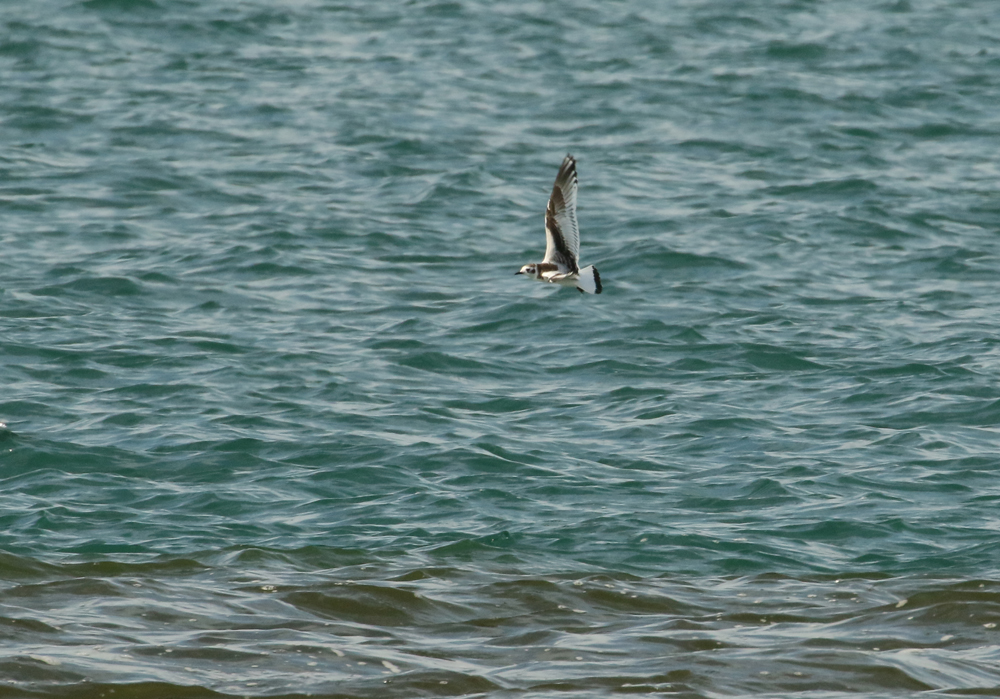
Little Gull

 It's been a while since I've had a late summer Little Gull.  I got out to the beach fairly late for me and found Will and Lisa already there.  There wasn't a ton moving and when Will followed Tim out to the end of the pier I debated how long I would stay.  But about the time they got to the end a bird appeared trailing a couple Bonaparte's Gulls.  The first thought that went through my mind was, "Why does that tern have a black M on its back?"  Because it's a Little Gull.

I jogged out to the end.

It's a juvie that's still in pretty fresh plumage.  It hugged the river water's edge and we hoped it would come in closer as the wind started shifting the river water closer to the pier but the boat traffic  dispersed the birds.

One montage of the bird showing off that dorsal black M.