Saturday, March 14, 2020

the Birds and the Bee(tle)s


We nearly had possibly the highlight of the trip when a herd of trumpeters went galloping past on our way back from the long walk through the forest.  Trumpeters are a cross between a kiwi and a crane, colored like a black-throated blue warbler that mixes in some cream highlights, and bolt through the forest garrulously yelping.  I don't know how we couldn't see one, it sounded like there were a hundred of them and close, too, but they Just. Kept. Going.  Another bird for the Maybe Next Time file.

We got back for lunch and I walked the grounds, getting a much better look at Green-backed Trogon.


The heat of the day was very much up and I didn't find much as I re-walked some of the same trail we did as a group had done the previous morning.  A couple of humping beetles was about the extent to what I saw.

I bailed on the forest and returned to the grounds.  A White-throated Toucan presumably on its way to a nest teed up holding a wild avocado.  I think this is the largest toucan I've ever seen.

The last bird was another that was uncommon enough (and easy enough to look up) that I didn't learn the name prior.
It's a Moriche (previously known as Epaulet) Oriole, the only oriole I saw the entire trip

Monday, March 9, 2020

The hotspot tree

Our second full day at Shiripuno found us motoring down the river at daybreak.  We went a few miles and then disembarked up a muddy bank so that Jason and Tota could machete their way to the trailhead.  We surprised one of the locals on the way...

 You know you're in a big chunk of forest when you're seeing quality mammals.  This Tapir literally lost its shit when we came around the bend.  He spun his wheels in the mud for a second or so cartoon-style, and then bolted into the underbrush.  And you know the jungle is dense when a 3 to 400 pound animal disappears immediately.

While waiting for the trail to cleared/found a few birds appeared at forest's edge.  A Lettered Aracari was probably the toucan class bird I was most looking forward to.


There's a number of Oropendolas that the book lists as rare.  I didn't learn many of the rare birds, so when the guides noticed an oropendola that one called Green and one called Olive-backed I wasn't in much position to figure the answer out.

But for once the Two Bird Theory was a solid one; it turned out they were on different birds.  The Green is the flyby with the blood-tipped bill, the Olive-backed is about to display launch on the right.

And with that we disappeared into the forest.  It was muggy and still and we worked to find any birds at all.  Jason impressively identified a fairly non-descript high-pitched note as a Dwarf Tyrant-manakin, and then even more impressively found the tiny green bird amidst multi levels of dark green foliage.

You can tell by how pixelated the photo is that it was Dark.

Fito and Jason tried to tape out a couple antbirds with limited success, but the frantic pressured calls of a pair of White-fronted Nunbirds (imagine a pair of cardinals singing after doing a few lines of meth) drew our attention to a big open dead tree that actually had birds!

We struggled to find flocks on this trip so a trio of Paradise Tanagers (they were joined by a larger Opal-rumped for a bit) who appeared next were very much a relief.

I glimpsed this species once last year, and they're still on the Better View Desired list, but just a reason to go back!

On the opposite side of the color spectrum a Grayish Mourner had none of the black, green, azure, or scarlet of the Paradise Tanagers.
Mourner translates loosely as "dull unicolored bird."  There's 4 mourners in Equador, but only 2 are actually related to each other.  If you go by the taxonomy they're about 20 pages apart in the book since some are flycatchers and the others closer to tityras.

A Female Green-backed Trogon split the difference between the mourner and the tanagers color-wise.

Finally a couple woodpeckers, first Lineated, a bird widely distributed in the tropics...

and finally Yellow-throated.  There's a few yellow or yellowish woodpeckers in Ecuador and we saw a couple, but this was the only one that was even semi-cooperative.

We spent probably 30 minutes just watching the birds come and go from this tree given how hard we'd been working to see a bird here or a bird there in the forest interior.  Someone commented the tree should be an eBird hotspot.  Fito thought the name could be "tree in the Amazon." He maayyyyybe was unconvinced.

Wednesday, March 4, 2020

the white witch and BOOMS in the black


We did more post dinner walks on this trip than previous ones I've done, and there were things to see.  We'd walk some of the trails with flashlights canvassing leaves and the ground turning up various big bugs, but also some larger creatures.

This is the biggest frog I've ever seen, note the boot on the right side of the pic...
(per my go-to resource on non-bird neotropical life forms, Josh Vandermeulen says this is a Smoky Jungle Frog ... and not even all that large of one!)

It easily could have gobbled up this snake, which while 3 feet long, was only millimeters wide
(Josh tells me something in the Imantodes genus, probably Blunthead Treesnake)

A sleeping malachite butterfly pretended to be a leaf.

Cookie picked up some eyeshine with her flashlight.  I was expecting a rodent of some kind, but we moved around the tree and saw an enormous moth.  A quick google search implies this is a White Witch, which apparently can grow to be a foot across.  This one was probably closer to 7 inches, but still huge.

We listened for night birds.  We were so far from civilization that no tapes were needed.  Tawny-bellied Screech owls both tremolo'd and hooted.  Pauraques called of course.  Great Potoo screeched their yowling cry while Common Potoo sang a descending minor key descant.  But distantly at dinner we'd started hearing one of the specialty birds of the Shiripuno River.  Boom Boom, boom-boom-boom ... BOOM.  Not a grouse, not a large owl, but Nocturnal Curassow.  A different group's guide said this bird's call could be heard from 2 miles away.  While that might be true this one, while distant, didn't seem more than a couple hundred yards.  And Jason, somehow, found the bird.
The pic is beyond terrible, it's up in the canopy walking right, heading down the branch.  You can see a bit of the pink bill and the blue skin around the eye to the right, as well as lighter brown undertail to the left under the bend of the branch.  Tired as we were, it was no joke hard to sleep with so many really unique sounds to listen to.

Saturday, February 29, 2020

Bailing the boat

Our typical pattern at Shiripuno would be to walk in the morning, siesta during the midday, and then as the heat started to fall off in the later afternoon bird the river by boat.  The sun started out bright enough that the butterflies were out in force.

This one is on guide Fito's hat...

Others (the black and green ones are Uraenia moths and the brown one some flavor of daggerwing) found salt and minerals from more traditional locations, like the mud at waters edge.  (Note how it's now somewhat overcast)

We kept heading down river and found birds.  The quickest way to ID the aracari toucans is to count the belly bands, this one is one-banded making it Chestnut-eared.  (It's even more overcast...)

Overcast gave way to rain and rain gave way to one of the more torrential downpours I've ever experienced.  It was dumping down in rivulets, just pouring out of the sky.  The bottom of the boat and was honeycombed  by inch and a half tall partitions of steel welded to the bottom of the narrow but flat-bottomed boat.  Let's just say the water level rose.  And rose.  And rose some more.  Eventually the water started cresting over the partitions in the back half of the boat.  If it had gone up farther the water could have flowed from one side of the boat to the other and swamped us going around a corner as 100's of gallons of water flowed to just one side.  We stopped and passed a bail bucket (err cutout milkjug) around.

The rain stopped eventually, but my shoes were SOAKED.  I'd kept my feet perched up on the partitions and partially shielded by my raincoat, but water pouring down my pants filled them with enough water I could pour it out once it finally stopped as we neared the lodge.

So needless to say not a ton of pics that afternoon, though this Bare-necked Fruitcrow flew up the river as we landed and then teed up in a snag above the lodge, one of the more unique birds I've encountered

Thursday, February 27, 2020

Monk Saki at lunch

After a long morning walk through the jungle we took a break at lunchtime for a few hours to let the heat of the day pass somewhat.  Of course breaks are ... relative.  I headed back into the woods.

Black Caracaras were very vocal, yelping and shrieking through the siesta time ... fortunately for the group they mostly hung around the guide's cabin. 


I looped around the grounds and a Black-fronted Nunbird flew into the trees in front of me.  Nunbirds have been possible on most of the trips I've done, but this was the first time I'd seen one.

Closely related to the widely distributed Squirrel Cuckoo, this Black-bellied Cuckoo was probably the prettiest cuckoo I've ever seen.

I honestly thought there would be more antbirds on the trip; certainly a lot were possible.  This Mouse-colored Antshrike was fairly vocal.

Walking further into the woods some rustling in the treetops revealed an impressive monkey, this one is a Monk Saki, my first saki monkey of any type.  Fito, our main guide, had never seen one.

Drab Water-tyrant on the other hand EVERYONE saw.  They were common flying along the river's edge and seen on every boat trip.  It was a lot easier to photograph from shore though

Finally a view of Striped Woodcreeper, which was part of one of the few small flocks we encountered.  It was joined by a pair of White-flanked Antwrens as well as a Plain-winged Antshrike which unfortunately I couldn't quite snag a pic of.
Sunday, February 23, 2020

the Tiscornia Scoter show

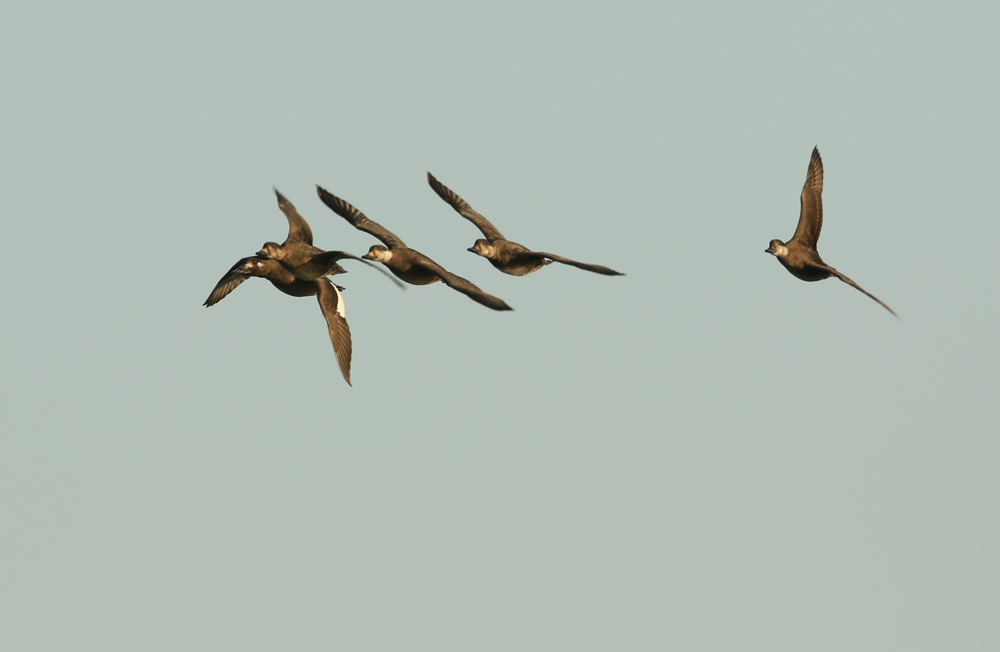
All 3 species of scoter have been seen on the pier the last couple days (though I didn't see the Harlequin Duck this morning).  But if you want to photograph black and white birds, what better time than first light?

The light gets away from you quickly...

While the White-winged's are the dominant species there were a few Surfs about.

And given that I forgot to eBird Black last year, I couldn't make the same mistake twice!  These guys almost lined up for a really nice composition, but that White-wing in front started banking a moment too soon

The "dark-winged" scoters, from the above shot wheeled past, if I only had the close-up pic below to go on, I might call them 2 blacks and 2 surfs... but studying the bill shapes of the top pic makes me think they're all black ... but I could be wrong.

And who knows, maybe the ice will soon be melted enough to let the algae get slick!

Friday, February 21, 2020

into the Shiripuno jungle

After spending Day 1 of the trip getting to Ecuador, and Day 2 getting into the Ecuadorian Amazon, Day 3 dawned with great promise.  We headed (where else?) into the woods.  Led by our guide's guide's guide (more on her in later posts) we started working the jungle.  The birds came in ones and twos, a few antshrikes and medium-large woodpeckers, before we rounded a corner and our guide's guide spied this Yellow-billed Jacamar.

It was fairly cooperative, and a lot lower and closer than just about anything we found on this walk.

No need for our guide, guide's guide, or guide's guide's guide for this one, Spangled Cotinga was spotted by one of the group as we searched for a calling woodpecker.

Tota, the guide's guide's guide, (or Dota? we were never quite sure) spied this White-crowned Manakin.  Given that she spoke mostly Wauroni (and honestly I think less Spanish than I do), figuring out what or where she was looking took some doing, but most of us got there in the end for this bird at least.  She seemed to know the trails well though.

This was the biggest glasswing-type butterfly that I've come across.

And this seemed to be in the wood-satyr class, but again twice as big.

Finally a minute waxy flower whose relation I won't even attempt to guess