Because Princeton Books has a suggestion!
No serious birder can have too many references from Steve Howell. I think this is at least the 3rd that I own and I feel that his style is transitioning. While Gulls of the Americas is a must-have reference, a lot of the text is in chapters of fairly dense description at the end of the book. This book is much more Sibley meets Crossley with every page dominated by pictures, usually with text at the bottom of the page, and at times annotated with Peterson like arrows.
Here's a sample for Parasitic Jaeger...
But it doesn't just cover birds we find now and then, it covers everything from all the penguins to all the albatrosses to all the storm petrels to all the boobies to ... you get the idea.
One of the best things about this book is that while overall the format is somewhat like Sibley (with photos instead of watercolors) with an intro plate showing small images of all the species in a grouping and then going into each individually with its own page more or less, he changes things up where necessary. If he needs to depart from that format to do a specific comparison of a given set of birds he does. Here's an example
Seabirds are incredibly complex and not everything is yet known with regards to aging and taxonomy; the authors do a good job of laying out where uncertainties lie.
I would recommend this book to anyone who is going to be spending time on the ocean. The photographs are excellent (apologies for the low quality reproductions here) and I think should give a person a reasonable gestault foundation from which to build in the specific points that the authors highlight.
And full disclosure, I got a free copy for writing a review! (though I've never seen any evidence that Princeton reviews the reviews).
Thursday, December 19, 2019
Friday, November 29, 2019
Black Friday Snowy
Mike Bourdon found a Snowy at New Buff this morning so Hazel and I drove down to take a look. It was still there, teed up in front of a post that the waves and wind had driven into the breakwall
It surveyed the harbor, perhaps wondering if Scaup could be on the Thanksgiving leftovers list.
I've been struggling this month to find the time to get out and find some photo targets, but the best two shots this month are a (mostly obscured) Barred Owl and a bright Red-shouldered Hawk
It surveyed the harbor, perhaps wondering if Scaup could be on the Thanksgiving leftovers list.
I've been struggling this month to find the time to get out and find some photo targets, but the best two shots this month are a (mostly obscured) Barred Owl and a bright Red-shouldered Hawk
Tuesday, October 29, 2019
last morning in Ecuador
Our last morning in Ecuador dawned overcast and misting. The lighting made birding pretty hard but we did manage some nice looks. After struggling to find a Yellow-tufted Woodpecker we did eventually see a group atop a snag, and then one right by the road.
Its much larger cousin Pale-billed Woodpecker provided some good looks as well.
A pair of Masked Tityras enjoyed the presence of the woodpeckers as they'd been provided a nest hole.
Our guide was very excited by this difficult to find Red-billed Tyrannulet
I was equally excited by a (considerably more common) Olive-chested Flycatcher. Their plumage reminds me of a fall Yellow-rumped Warbler which made a subtle ID much easier.
Yellow-tufted Dacnis is considerably easier to identify
Finally a look at Magpie Tanager, another bird I expected to be common but we didn't find until the end of our final morning.
Its much larger cousin Pale-billed Woodpecker provided some good looks as well.
A pair of Masked Tityras enjoyed the presence of the woodpeckers as they'd been provided a nest hole.
Our guide was very excited by this difficult to find Red-billed Tyrannulet
I was equally excited by a (considerably more common) Olive-chested Flycatcher. Their plumage reminds me of a fall Yellow-rumped Warbler which made a subtle ID much easier.
Yellow-tufted Dacnis is considerably easier to identify
Finally a look at Magpie Tanager, another bird I expected to be common but we didn't find until the end of our final morning.
Sunday, October 13, 2019
California Gray
Yesterday, the first day after a front had come through, saw 4 digits worth of ducks go by Tiscornia. This morning ... there were less. Probably in the order of about 10%. Gulls were moving well yesterday and the group were watching for Franklins in addition to sorting through the ducks ... but the only Franklin's turned up in New Buff. When it was re-seen this morning we decided to bail on Tiscornia and look for the Franklins. I figured best to check Silver just to make sure there wasn't a Franklin's a mile away without driving to the other side of the county.
There indeed was a darker mantle present ... but only one shade darker than the ring-billeds.
The dark eye and mantle had me jogging back to the car for the scope and camera. Sure enough, the long red-and-black ornamented bill, yellow-green legs, and fully dark eye of a California Gull popped out. It looked to be an adult well on its way to winter plumage with heavier nape markings than our local rat gulls typically display.
When I moved to Berrien in 2006 there were just over a dozen records for Cal Gull in Michigan. There's triple that number now, and three quarters of those have been here in Berrien.
Unfortunately there was no Franklin's Gull in New Buff, but Mike Bourdon found a fun consolation prize in a Cattle Egret. I've actually seen Cal Gull more often than Cattle Egret in Berrien
There indeed was a darker mantle present ... but only one shade darker than the ring-billeds.
The dark eye and mantle had me jogging back to the car for the scope and camera. Sure enough, the long red-and-black ornamented bill, yellow-green legs, and fully dark eye of a California Gull popped out. It looked to be an adult well on its way to winter plumage with heavier nape markings than our local rat gulls typically display.
When I moved to Berrien in 2006 there were just over a dozen records for Cal Gull in Michigan. There's triple that number now, and three quarters of those have been here in Berrien.
Unfortunately there was no Franklin's Gull in New Buff, but Mike Bourdon found a fun consolation prize in a Cattle Egret. I've actually seen Cal Gull more often than Cattle Egret in Berrien
Thursday, September 19, 2019
Sumaco Antpittas
In the afternoon at Wild Sumaco we took a hike to a little grotto where Ochre-breasted and Plain-backed Antpittas came in for worms. There was actually a second group that was heading there as well and the group got spread out pretty far single-file on the trail. I forget what bird the front of the line glimpsed, but those at the back of the line heard a fairly unique call from the underbrush. The leaders were far ahead and we were forced to leave it be to settle in at the antpitta spot.
Initially all we saw was a (locally rare) Gray-cheeked Thrush that was hoovering down the worms at a rapid rate...
After a bit of a wait a tiny Ochre-breasted Antpitta started appearing. This isn't a bird a person can get tired of seeing.
We caught only glimpses of the much larger Plain-backed however. This photo is brightened from near blackness, I'm impressed it turned out as well as it did.
Ironically on the way back the bird we'd heard on the way in was still calling. We brought it to the guide's attention ... as a Chestnut-crowned Gnateater (another antpitta-like bird even smaller than the Ochre-breasts) flashed through my binocular field for a quarter of a second. I called it out and the call clicked in on the guide, we'd been hearing the Gnateater on the way out too! Unfortunately (or fortunately to have brought the bird at all) a host of ants were foraging on the trail, and we got pushed back, some of us (including me) with a bunch of bites.
Initially all we saw was a (locally rare) Gray-cheeked Thrush that was hoovering down the worms at a rapid rate...
After a bit of a wait a tiny Ochre-breasted Antpitta started appearing. This isn't a bird a person can get tired of seeing.
We caught only glimpses of the much larger Plain-backed however. This photo is brightened from near blackness, I'm impressed it turned out as well as it did.
Ironically on the way back the bird we'd heard on the way in was still calling. We brought it to the guide's attention ... as a Chestnut-crowned Gnateater (another antpitta-like bird even smaller than the Ochre-breasts) flashed through my binocular field for a quarter of a second. I called it out and the call clicked in on the guide, we'd been hearing the Gnateater on the way out too! Unfortunately (or fortunately to have brought the bird at all) a host of ants were foraging on the trail, and we got pushed back, some of us (including me) with a bunch of bites.
Saturday, September 14, 2019
Sumaco hummers 1
It should not have taken me this long to get the next post up, but what can you say. Life gets busy.
Wild Sumaco was at mid elevations which typically gives the highest hummingbird diversity and this location was no different. The smaller hummingbirds had a lot of adornments, giving them a very alien feel. This is Wire-crested Thorntail (a full breeding male will have head and tail plumes that are twice as long).
Here's a couple of the females arguing over the flower patch...
Here's the west slope version for comparison (I tried to link to the post that had these but can't search it up no matter what I do, maybe I forgot...)
Wild Sumaco was at mid elevations which typically gives the highest hummingbird diversity and this location was no different. The smaller hummingbirds had a lot of adornments, giving them a very alien feel. This is Wire-crested Thorntail (a full breeding male will have head and tail plumes that are twice as long).
Here's a couple of the females arguing over the flower patch...
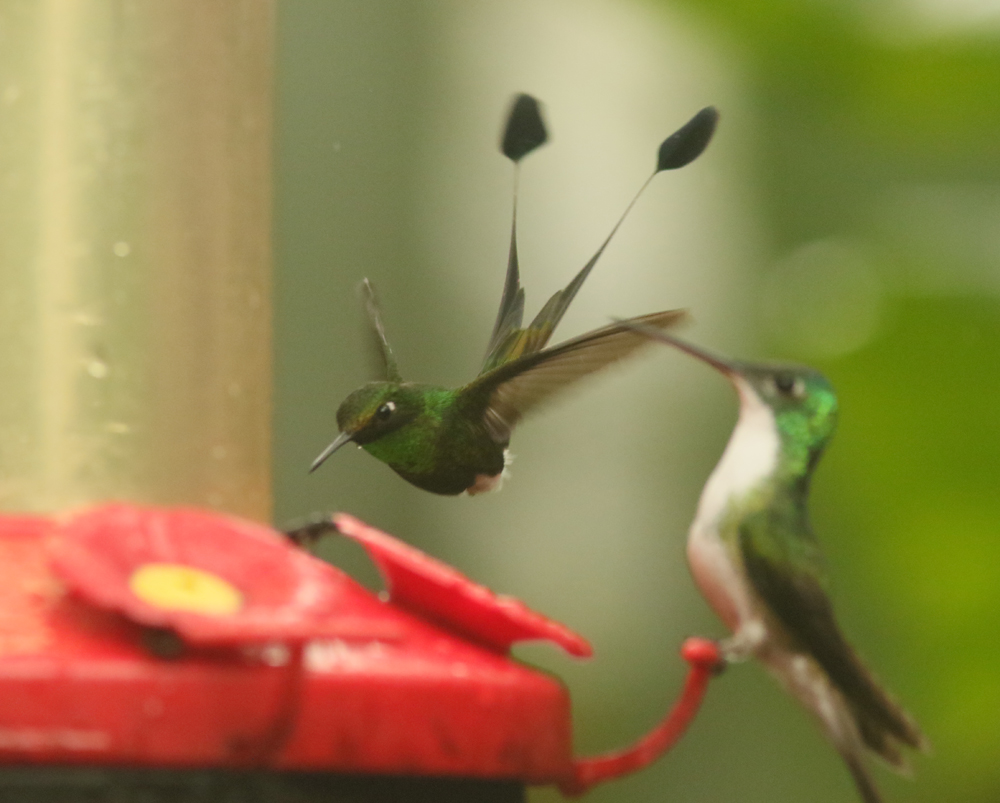
Booted Racket-tail is perhaps the hallmark species at Tandayapa, the famous lodge on the other side of the Andes we visited last year. On the east side of the Andes the boots are orange rather than white. It gave them a very different feel, and somewhat of a warmer one somehow by adding more color but less overall contrast
Here's the west slope version for comparison (I tried to link to the post that had these but can't search it up no matter what I do, maybe I forgot...)
Sunday, September 1, 2019
Bonaparte's gone fishin'
It's Labor Day weekend, so time to take time off and relax right? Some fresh juvie Bonaparte's Gulls have joined the fishermen on the pier and at times are foraging fairly close. They fly a few feet above the surface, side-slipping at times to dip into the water, frequently plunging their entire heads and necks below the surface taking back off.
It was hard to tell if they were catching anything with the naked eye (or with bins) though some prominent crops were suggestive of success. Freezing the birds with the camera revealed they were being successful about a quarter or a third of the time.
Finally a fall pic that probably won't fit well elsewhere, a Song Sparrow in some smartweed...
It was hard to tell if they were catching anything with the naked eye (or with bins) though some prominent crops were suggestive of success. Freezing the birds with the camera revealed they were being successful about a quarter or a third of the time.
Finally a fall pic that probably won't fit well elsewhere, a Song Sparrow in some smartweed...
Subscribe to:
Posts (Atom)