I wasn't the only one attracted to the concentrations of birds following the tides. There were good numbers of eagles slowly cruising along (more on them later) as well as a merlin that would strafe the shorebirds. The merlin would push the sandpipers up to a quarter mile up or down the beach as prey tried to keep their distance from predator. I accidentally walked right up to a couple Wilson's Plovers after this happened moving at normal speed thinking the beach was empty.
Instead of flying the Wilson's had hunkered down on the drying mats of seaweed and blended in amazingly well.
This is presumably a first spring bird.
I heard this one calling the day before and tracked it down since I wasn't familiar with the call.
There were also a few Piping Plovers around. I haven't yet tried to track down the bands on these two birds.
This first spring bird had escaped detection in the nest.
Finally a Black-bellied still in full winter plumage. They were definitely a bird to be aware given their hair-trigger proclivities for alarm calls.
I saw a few Semi-palmateds around but made very little effort to photograph them. Almost 13 years ago I found my lifer Snowy Plover across the bay on Sanibel (yes, on my honeymoon), I didn't see a Snowy at all on this trip.
Tuesday, April 14, 2015
Sunday, April 12, 2015
Florida like a tourist
No bird says Florida like the long-legged waders. I spent some time with them. I took relatively few pics of White Ibis, but couldn't resist this first year bird as the sun just came over the horizon.
The birds at the beach near the hotel were quite tame and ignored me as I worked my around them to get the sun in the right place in the morning light.
The Little Blue and the Snowy seemed to be trying to nab whatever the ibis displaced. The birds squabbled a lot less than I expected them to.
They eventually went their separate ways.
The Snowy was a lot harder to meter than the Little Blue
In retrospect I probably should have tried some different white balance settings rather than just sticking with the one I typically use for morning light given the whiteness of the bird.
Thursday, April 9, 2015
the Baddest Shorebird
I'd never seen an Oystercatcher up close before. They were much bigger than I expected. Per Sibley heavier than Little Blue or Tricolored Heron, twice as heavy as a teal and a couple ounces bigger than a Wood Duck.
Here it is compared to a Sanderling
A Western gets too close for comfort...
They had a couple different feeding styles, sometimes getting low and probing forward,
at other times sewing like a dowitcher...
They two birds wandered around, I couldn't really get a sense of what they liked to feed in the best, they seemed equally interested in the exposed beach and the last of the tidewater.
Eventually they took flight and moved 30 yards down the beach.
Tuesday, April 7, 2015
shorebird reflection shots
Bunche Beach in Fort Myers was a really great place to take pics in the early morning light (what will be a recurring theme over the next 2 weeks). This is a collection of shorebirds-and-their-reflection. Most are just starting to get some breeding plumage coming it but are still mostly in their winter drab.
Dunlins were one of the most common birds and one that I didn't take a ton of pics of
Western Sandpiper on the other hand ...
I couldn't get over how many Westerns there were along the gulf. I'm not sure if they were wintering or just stopping over in a leg of their migration.
I'm going to do an entire post probably on the peeps, I'll stick with these Leasts for now.
I've read that a simple evaluation of whether there's decent light for photography is that your shadow should be longer than you are. I'm not sure what it says that the Least Sandpipers' shadows were nearly longer than I am
Wilson's Plover wasn't super common but was present most of the mornings. I kept blowing them off as Semi-palmated's when I'd look with the naked eye since they fell into the brain's search image of "small, brown, one band, bright legs" and nearly filtered them entirely more than once.
no problems with Ruddy Turnstone, nothing else has their bill and legs.
I'm always surprised by the prehensile billtips of dowitchers (a short-billed in this case)Dunlins were one of the most common birds and one that I didn't take a ton of pics of
Western Sandpiper on the other hand ...
I couldn't get over how many Westerns there were along the gulf. I'm not sure if they were wintering or just stopping over in a leg of their migration.
I'm going to do an entire post probably on the peeps, I'll stick with these Leasts for now.
I've read that a simple evaluation of whether there's decent light for photography is that your shadow should be longer than you are. I'm not sure what it says that the Least Sandpipers' shadows were nearly longer than I am
Wilson's Plover wasn't super common but was present most of the mornings. I kept blowing them off as Semi-palmated's when I'd look with the naked eye since they fell into the brain's search image of "small, brown, one band, bright legs" and nearly filtered them entirely more than once.
no problems with Ruddy Turnstone, nothing else has their bill and legs.
Saturday, April 4, 2015
The mad linebacker of the flats
... is someone's description of Reddish Egret. I was thinking it was Peterson, but that phrase isn't in his guide when I checked just now. I'm thinking it's probably somewhere in a Pete Dunne essay.
Reddish Egret has a very narrow range in the U.S., I hadn't really realized how restricted their habitat is, but didn't have any decent pics of the species before this trip. On our first evening we went to a beach a mile from the motel and I spotted one up the beach. It didn't take long to walk over to it.
I don't usually center the subject in the exact middle of the frame, but I liked the symmetry that the dunlins randomly configured themselves into. I walked out into the gulf for a better angle at the bird.
I was back at the beach at absolute first light the next morning and there were a few more feeding, staggering about the tidal pools. Peterson's description alluded to their drunken feeding habits.
In a first for the blog I made a gif of one of them careening about the pool
There was an immature in the same area, the rich morning light gives it credit for much more color than these very dull bird typically display.
A final view of one of the adults in flight.
Friday, April 3, 2015
Forget the appetizer
Don't get me wrong, I like April migrants as well as the next person. Birds like Fox Sparrow, Hermit Thrush, and Yellow-bellied Sapsucker all herald the May migration that is to come. That being said, they're the appetizer that leaves you hungry for the main course - the bulk of the passerine migrants, especially the warblers to most birders. (We'll leave dessert, the vagrants, for another few weeks).
We took the kids to Florida for spring break for a little less than a week allowing me to skip right to the warblers. The really fun thing was that while the 1st, 2nd, and 3rd most common warbler here at the end of the month will be Yellow-rumped (followed by Nashville and Black-throated Green and their ilk), the warblers (with the exception of the wintering Palms) were fairly different along the Gulf coast.
The most common migrant I found was Hooded Warbler.
They seemed to forage much lower than they usually sing on territory around here.
The next most common was Northern Parula of all things.
The females especially seemed to like foraging in an unfamiliar fruiting tree that was attracting a lot of small insects.
I'd never heard the bill snap of a warbler capturing a gnat, but it was a sound a person could get used to. When we hiked at inland spots (most of these pics are taking by the Ybel lighthouse on Sanibel) the male parulas seemed to be on territory. This next bird was the only one I actually saw.
Prothonotary was also pleasantly common.
I think this last one has a piece of fruit that dropped off the tree in its bill. It dropped it after a few seconds.
I've never spent a lot of time at true migrant traps, but this one 5 miles and a tollbridge away from the motel was well worth it. While the above 3 species accounted for the majority of species there were a few others about. I glimpsed Worm-eating twice, missed Swainson's by an hour, but did get nice pics of what appeared to be a migrant Yellow-throated.
I maneuvered a little closer but was shooting through some leaves.
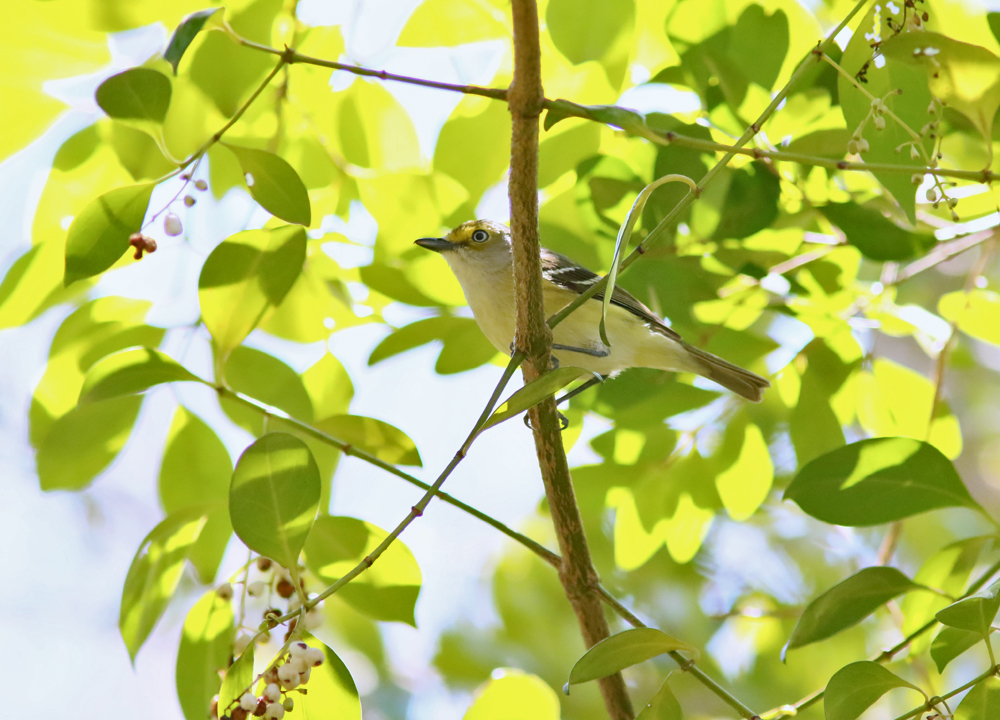
White-eyed Vireo wasn't really a migrant; they were singing on territory in a lot of spots.
Wednesday, April 1, 2015
The emblem and the runner-up
You'd think after a month and a half of writing about Costa Rica I'd have a backlog of topics for Berrien. I have a few pics of a Thayer's Iceland integrade and some pics of a Glaucous Gull with landfill trash ... but nah. Speaking of the landfill this eagle was there too...
We all know the apocryphal tales that Ben Franklin wanted Wild Turkey as the national emblem. These 2 were investigating the feeder sometime mid-month.
The last 2 pics were with the small lens ... exercise those wings,
We all know the apocryphal tales that Ben Franklin wanted Wild Turkey as the national emblem. These 2 were investigating the feeder sometime mid-month.
The last 2 pics were with the small lens ... exercise those wings,
just hanging out under the deck...
Subscribe to:
Posts (Atom)