Monday, February 16, 2015

My favorite highland hummingbird ...

 the White-throated Mountain-gem, foraging here in a lightly falling rain.


I've taken reasonable pics of the female before, but this was the first time I'd gotten decent pics of the male on natural perches.


A few more flight shots...

Sunday, February 15, 2015

Real and fake flycatchers

I think my 3rd lifer on the trip was this black-and-yellow silky.  In some books the silkies are referred to as silky-flycatchers.

 The male is above, the female below.  After never seeing one in two prior trips, I think we saw 3 or 4 over the course of this trip.
The thing is, they catch fruit, not flies. 

The other silky-(flycatcher) is the Long-tailed.


The female is perched on the branch above the male in the next pic.
One of the Panama guidebooks speculates that these are actually most closely related to waxwings.

Of course true flycatchers don't always flycatch.  Mountain Elaenias also like fuchsia fruit.

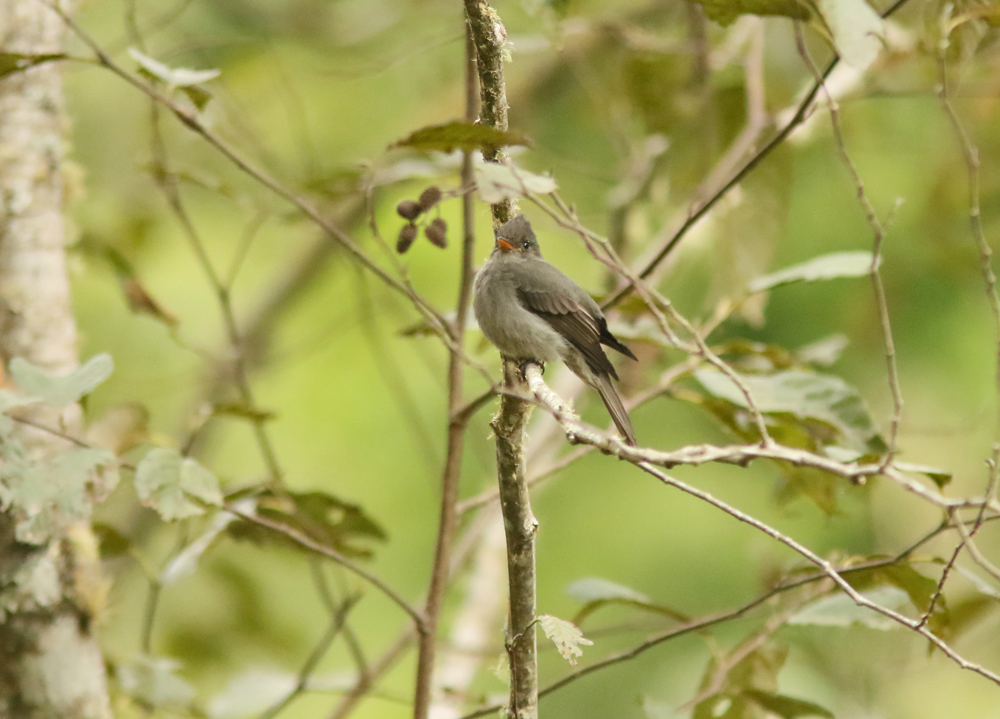
Next is a Yellowish Flycatcher, one of 3 empids we don't have that can be seen in CR.  It certainly has the appearance of a bird in the Cordilleran/Pacific-slope (formerly Western) group given the warm colors and strong teardrop white eyering.

Dark Pewee is nearly a Costa Rican endemic, just barely getting into Nicaragua and Panama.

Torrent Tyrannulet is a unique little bird found along the rapids.

Saturday, February 14, 2015

Two thieves

We all know about flowers and nectar and pollination, for some flowers the pollinators are hummingbirds, for most it's bees or other insects.  We came across a couple birds that cheat however.

The Slaty Flowerpiercer is one of those birds.  They use their oddly shaped bill to grasp the base of a flower and then poke a hole in to drain out the nectar, bypassing that whole messy pollination process.


They're not the only one who does this.
 On each trip I've made into the highlands I've seen Stripe-tailed Hummingbirds nectaring from the holes the flowerpiercers make.

The Stripe-tailed's looked to be moulting.  These birds were a couple hundred yards apart and on opposite sides of a river
 Both are down to 3 primaries which remarkably was sufficient.

Not so with the Violet-ears, whose plumage seemed fairly pristine.

Thursday, February 12, 2015

La Quebrada Trail

After connecting with the quetzals before breakfast we took a jeep halfway up the mountain above the Savegre Valley looking for the various small songbirds found in the mixed flocks.  We had some success, though the flocks tended to be fairly high and somewhat disparate.  Rhoda pulled out an Olive-striped Flycatcher for my first lifer of the day, though it slipped past before I could get a pic.

Sooty-capped Bush-tanager (now Chlorospingus) is one of the characteristic birds of the highlands

Probably the highlight of the morning was a close look at my second ever Streak-breasted Treehunter.  It acted like a foliage-gleaner, which isn't a great description for those not initiated in the neo-tropics.

It had the body size probably of a Hermit Thrush but with a much heavier bill and a long rufous tail and foraged with the style and activity of a creeper crossed with a kinglet.  It was close enough that its size made it very difficult to photograph; if autofocus was relied upon then the shoulder would be in focus and not the head.  It didn't hold still long enough to focus on the head and then move the frame to center it.

Black-cheeked Warbler is another very hyper bird,
 the opposite of Black-faced Solitaire, a bird that doesn't move at all while calling out with beautiful clear ventriloquial tones.

Warblers became more prominent as we headed down.  Flame-throated and Black-throated Green were dominated in numbers by the ever-present Wilson's Warbler.

We had a brief look at a pair of very local birds, the Barred Becard.

Golden-bellied Flycatcher is a bird I've seen each time I've birded this area, but never more than once or twice.
 It favors the treetops which makes it a hard bird to photograph.  Other treetop dwellers we heard but couldn't find despite a good deal of effort were Ornate Hawk-Eagle (doh!) and Rufous-browed Peppershrike.

A view of the 4x4 vehicle that crammed all 8 tour participants in the back with room for the driver and Vernon, our guide, in the front.
Pictured are Brian, Cathy, and Lyle.

Wednesday, February 11, 2015

the annual Quetzal tease

We saw 3 quetzals, 2 females and a male in a little glen in the highlands.  They didn't like to sit in the sun, that's for sure, and clearly didn't like exposing the flaming red belly to the assembled birders.

 
This shot is the closest I've come to a male pic in the sun.  There was a tiny window in the foliage to get this peek.

They perched up in pretty good view at least.


 Eventually the male took up a position high in a tree where you could see the belly.

As we were leaving I was hearing this female but thought she sounded much farther up the slope.
I ended up walking right underneath her and didn't see her until I turned back around.  She has a tiny spot of red to the right breast, not sure if this is age-related or not.

Tuesday, February 10, 2015

Costa Rica's Ugly birds

They can't all be tanagers and pygmy-tyrants.

Presenting the Large-footed Finch...
 
Because who wouldn't be attracted to a baby poo olive bird with a disheveled racket shaped tail and a contrasting mis-matched charcoal head.


Next, the Slaty Flowerpiercer, a gray bird with a deformed bill whose song was a twittering high-pitched jumble of notes.
 They're actually a fairly interesting bird, I'll come back to them in a few days.

Finally a bird that doesn't really belong with this title since they're quite attractive, the Yellow-thighed Finch.

Both finches are Chiriquí endemics found in similar habitats with similar behaviors that I've kind of linked together in my mind.

Sunday, February 8, 2015

Fun at Miriam's

Miriam's restaurant is a small lodge/restaurant set-up a little outside of the Savegre Valley that we've visited each time we've gone to the highlands.  This year it was as active as I've ever seen it.  The low sun starting to dip closer to the mountains behind the vantage point creates excellent lighting.

I've never gotten tired of seeing Flame-colored Tanagers there.
 The first bird is probably a first winter male; his ground color is still yellow-orange.  The next bird has the full flame color though is in the shade.

Acorn Woodpeckers are the dominant woodpecker in the highlands.  They were fairly vocal as well.

A lot of the Chiriquí endemics can be found here like Sooty Thrush,

the ever cute Black-billed Nightengale-thrush,

 and the Yellow-bellied Siskin.
This was the best look I'd had at this species which is usually more common in the treetops.
 
Mountain Elaenia is a more widespread bird found at higher elevations throughout Central and northern South America.

I didn't remember these flowers in years past at this location.  I'd threatened to photoshop the hummers at Paraiso like in the banner on the blog; none was required here with this magnificent.


or with a small Selasphorus, Volcano Hummingbird.

The Volcano Hummingbirds in this section of Costa Rica have a fairly unique grayish-lavender gorget.  I'd gotten distants shots at adult males in the past, this was the first time I'd been close to one however.
On some of the other volcanos they have pinker or rosier tones.