Thursday, April 28, 2011

Black-throated Green Sparrow?

The weather is finally turning, yesterday's birding was essentially rained out so I did some of the office work I had hanging over my head. Today was overcast with a few sprinkles here and there and I could finally spend a full day outside.

This BT Green warbler was a first on a couple fronts. I think it's probably the first time I've seen one forage on the ground (though with the trees barely even budding perhaps the may-apples are the closest thing it could find to canopy). I know it's the first time I've ever had my first of the year BT Green as a seen-only bird; usually the zee-zee-zee-zoo-zee floats down from the treetops first.
White-throated sparrows, on the other hand, are abundantly seen in the undergrowth.


I've always had trouble with processing my ruby-crowned photos, they always seem oversharpened. Maybe I just need a better image to start with.


Off course it's spring, so more flower pics, I think my best ever of Wild Ginger:


Marsh Marigolds are peaking at Floral too.


I tried getting some reflection shots, this one would have been better had it not included the two blossoms in the entire swamp that are past their prime:


Monday, April 25, 2011

Easter finches

I had my first of the year Purple Finch on the feeder on Saturday while we were getting ready for Easter festivities. I took a little time-out to stand on the back porch and fire a few frames. Most years I see Purple Finch on the feeder in late March. Either they were late this year, missed my feeder with the first wave of birds, or I just haven't had time to notice them.
For some reason the white in front of the eye always stands out more to me in photos than it does in real life.


Goldfinches continued the Easter egg-colored bird theme.


My schedule will finally relent some later this week, hopefully enough to allow somewhat more regular posts...


Saturday, April 16, 2011

it must be spring ...

I write as it was practically snowing on the way home from work this evening. I did finally get over for the wagtail a day ago, a really lousy digi-scoped video grab is at the end, until then it's the expected migrants and flora of mid-April... I caught this kinglet as it reached for a tiny insect presumably, though for all I know it's searching for tree plankton. This Fox Sparrow is from Tiscornia
There was a Hermit Thrush on the sidewalk as I walked into the house tonight. This one's from Floral though.
The requisite shots of some of my favorite spring wildflowers, bloodroot,
Trout lily,
and Dutchman's Breetches

Finally the Wagtail. Tim got a flight shot that I think is pretty supportive of it being an alba White Wagtail, rather than the lugens Black-backed subspecies, based on the flight drawings in Sibley, but I could be wrong. My pic, on the other hand, is only about half a step past the I-guess-that's-not-a-Gray-Jay level of identification.

Tuesday, April 12, 2011

Yellow Wagwings

I haven't had time in my schedule to chase the White Wagtail, but we did see a heck of a lot of flickers a few mornings ago. A good overnight SE wind with a lot of movement on the radar led to a lot of bird's reverse migrating along the lakeshore the following morning, headlined by close to 400 flickers. With that many birds surely one will be close enough for a pic right??? It was harder than I thought since woodpeckers' undulating flight leads to a lot of time with their wings folded as evidenced in this montage:
Flickers are easy to ID on the wing, other birds are harder, with different field marks in flight than perched. Shape and proportion plays a big role, but calls can help, like with these pipits,
or the bzzz of this Blue-gray Gnatcatcher,
or the seeee of these waxwings.
Other times you just have to look for the odd bird out of the flock, which frequently is a cowbird (see the leftmost bird in this group)
Sometimes, though the bird will take pity on us and land in the tree under which we're standing...

Saturday, April 2, 2011

How bluebirds invented email...

... during the Civil War no less. OK, so this one is going to be a bit of a stretch. I haven't had occasion to do a SORA search lately, but in my first walk into the river bottom this spring, I ran into a couple bluebirds. They were fairly cooperative, working the same opening that held a couple phoebes and assorted robins, creepers, and kinglets. I was a little surprised to see that they were both males foraging calmly without any territorial disputes. I tried to look up in the literature when bluebirds pair-bond. There were a couple of gems that came up in the search, one from the Wilson Journal (Alsop 1971) describing how a family of bluebirds got entirely too mingled with a feeding flock. One of the juvies tried begging from a Great-crested Flycatcher which promptly copulated with it. There was another one (Gower, 1936) that describes how an author in the 1860's had termed the structural blue layer of feathers "email" of all things.
There's actually a fair amount of bluebird research that's been published from Michigan. Benedict Pinkowski wrote a number of articles and short notes from a study area in Macomb in the 1970's. He found that the initial nesting period where eggs were laid was from April 6 to May 15. I guess these two aren't horribly behind, especially given that it's been cold enough that not a lot of stuff is singing. A Depression-era article from Illinois (Musselman, 1939), described how generally the bluebirds would time their breeding such that their eggs would be hatched prior to the return of House Wrens since the wrens apparently will pierce the eggs to try to free up a cavity for their own use. Years with cold snaps forcing the bluebirds to re-lay would lead to much less breeding success since more nests would then be able to be destroyed by wrens. Both eBird and Jon's recent 10 year review show essentially identical bargraphs for House Wren, numbers increase rapidly in the last half of April until they're pretty much back in force by the beginning of May. I hadn't realized that House Wrens had such a negative effect on Bluebirds, but a Wisconsin study of 2600 nests (Radunzel et al, 1997), found that House Wrens accounted for about 40% of the total nest failures in bluebirds, the same precent of the total failures attributable to cats and House Sparrows combined! Interestingly their study also found that bluebirds preferred to nest in standard bluebird boxes, but had higher fledging rates in open topped boxes since wrens avoided these.


The cardinals on the other hand are fully territorial. This one briefly popped up to some soft pishing.
as did this Fox Sparrow, though I only managed to improve my view from completely obstructed to mostly obstructed.

Works cited:

Alsop, FJ. Great Crested Flycatcher Observed Copulating with an Immature Eastern Bluebird. Wilson Bulletin: 83 (3) Jul-Sep, 1971.

Gower, C. The cause of blue color as found in the bluebird (Sialia sialis) and the Blue Jay (Cyanocitta cristata). Auk: 53(2) Apr-Jun 1936.

Pinkowski, BC. Annual productivity and its measurement in a multi-brooded passerine, the Eastern Bluebird. Auk 96(3) Jul-Sep, 1979.

Musselman, TE. The effect of cold snaps up ont the nesting of the Eastern Bluebird (Sialia sialis sialis). JFO 10(1) Jan, 1939.

Wuepper, JT. The Birds of Berrien County Michigan 10 year Summary 2000-2009. Berrien Birding Club. 2011.

Radunzel LA, DM Muschitz, VM Bauldry, and P Arcese. A long-term study of the breeding success of Eastern Bluebirds by year and cavity type. JFO 68 (1) winter 1997.

Thursday, March 31, 2011

Slow beginnings

Between consistent north winds and limited free time I've fallen fairly behind on posting. Most of the birds at Tiscornia have been way out over the lake though this Common Loon came in closer than most. With the northerly winds at least as many birds are going south as north, at least close to the pier.
There have been a few mornings with nice morning light. The car worked well as a blind at a local pond for these ruddies. I'd like to get out in the kayak on one of the Grand Mere lakes though I don't know that there's going to be time.


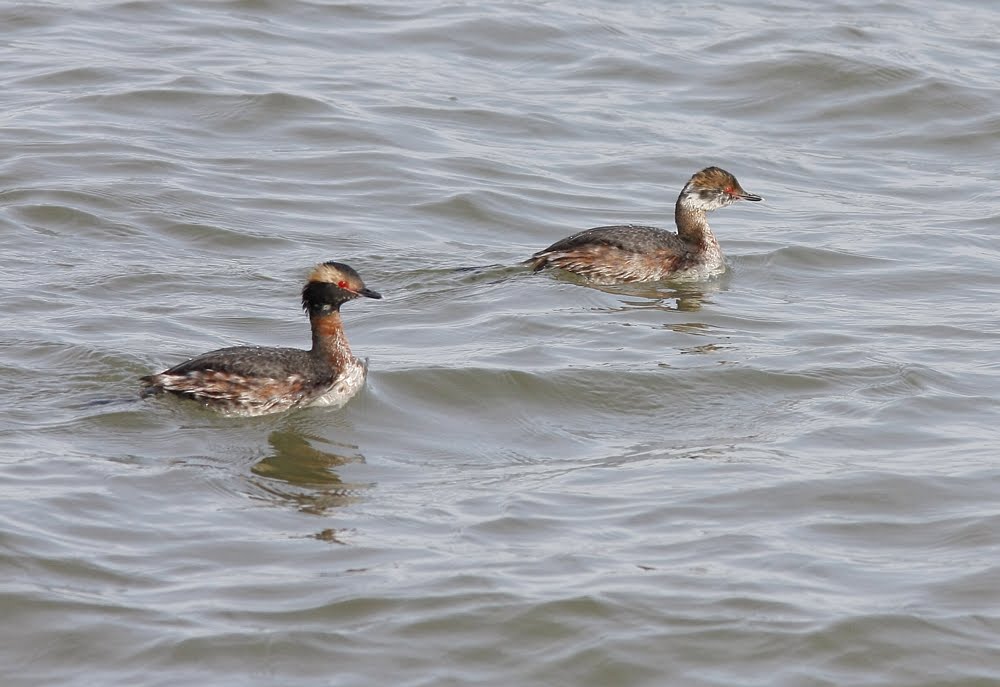
It feels like there's been fewer Horned Grebes about the piers, but maybe it's just the north winds slowing things down. They range pretty much from close to winter to close to breeding. Some are in the potentially confusing intermediate state.
I'm not sure if they can be aged at this time of year. There are some head shape differences between sexes in the winter, but I'm not sure how reliable they are once they start getting plumes. Presumably there's differences in the migration timing between sexes and age groups. It feels like the birds' molt is farther advanced this year than last, but perhaps I'm seeing adults now and more slowly molting younger birds are still to come.

Monday, March 14, 2011

Great goose round-up

There's been some decent year birds around lately though I haven't had a ton of time to write a lot about them. The goal for a Berrien year lister is always to find as much stuff out of the way in the spring so that a minimum of birding time can be spent away from Tiscornia in the fall when there's greater rarity potential (not that I didn't probably have a distant Black-tailed Gull a couple weeks ago).

It took an hour and a half of walking though the Sarett pines with my head cricked back before I found a Long-eared; owls and geese are among the earliest migrants though this bird could have wintered. This was at least my 4th trip into the pines this year though.
Speaking of geese, we've had some decent SW winds in the last few weeks which makes it a lot easier to find White-fronted and Ross's types.

Three Ross's types have been seen at a farm pond along Buffalo Road. Ross's are no longer a review bird in Michigan fortunately. I wrote a post a few years ago showing a range of birds and how they were viewed by the committee. I think these would be accepted if this was back then. What they actually are, may be another matter. Personally I think all eastern Ross's have at least some Snow in them given the massive population expansion Ross's underwent at a time when Snow Geese were moving into new areas both on the wintering grounds and in the arctic. That's not to say they're not Ross's Geese, I just believe that what a Ross's Goose is has changed. The other post reviews the literature I was able to pull off SORA regarding this.

I was somewhat lucky that I was delayed in being able to chase the Ross's Geese. Had I gone first thing in the morning I wouldn't have heard about these Cackling Geese in a holding pond in Sodus from another birder. There's another similarly sized group out of the frame. Note the vertical foreheads, stubby bills, and smaller size than the Canada Goose in the foreground. In life they were also slighly grayer than the Canada, but that doesn't come out that well in this distant backlit pic.
The other advantage of driving after these Cacklers was that a Mockingbird perched up in a fruit tree on the way back.

Finally a distant through-the-fence shot of 3 White-fronts at 3 Oaks.