Saturday, August 7, 2021

No storms at New Buff

 A line of thunderstorms appeared to be bearing down on the northern half of the county this morning, but New Buffalo looked clear, so New Buffalo it was!

An solitary Avocet awaited the sunrise.  It's still mostly in breeding plumage, though you can see some winter gray coming into the face


The avocet dwarfed the Killdeer that walked past it, which in turn dwarfed an adult Semipalmated Plover who also enjoyed some morning sun.


I like the composure better of the bird on a rocky Great Lakes beach, but there was less sunrise at this point...

The most interesting birds were a couple mergansers which (8/12 edits after a communique from Adam lol italicized), after some study, turned out to be Red-breasteds Hooded's in eclipse juvenile plumage.  A few years ago there were a pair of eclipse Common Mergs (that I didn't get right) so hopefully take 2 was a success! (nope). Of course the pics are absolute garbage so I'm not leading off with them.  But the pink bills (and size in comparison to Mallards) crossed Hooded off the list. made me think they couldn't be Hooded and I must have rounded up their size in my mind.  The shape did seem a little off, but I couldn't get past the pink bills.  Sibley doesn't show young hooded with bright bills, but some internet searches pull them up pretty easily.  Common in eclipse would have a much stronger demarcation between the neck and the breast.

There's some much better phone-scoped video of the birds that shows the color a lot better than this really low light effort


Wednesday, July 28, 2021

Ann Arbor Spoonbill

Heavily birded Washtenaw County has done will with rarities, with a redshank a year or so ago and now another first state record in Roseate Spoonbill.  

I made it there on about day 3 of its week and a half long stay.  The bird was out of sight when I arrived, but after a while a Great Blue took off and flew back to the back corner of the marsh, and less than a minute later the spoonbill flew out.  It landed distantly, then flew much closer and proceeded to feed.


I'm not sure I've ever seen one feed at close range.  The base of the bill was a lot more square than I remembered and the bird would bob its head somewhat as it swung its neck back and forth while working its bill to filter the water.  

With the two hour drive ahead of me that I wanted to finish before darks I didn't wait to see how long it would stay and found myself walking away from a simply crazy bird.

Friday, July 23, 2021

a Tiscornia lifer

 though it looks like I eBirded a Short-billed at Tiscornia 10 years ago ... who knew?

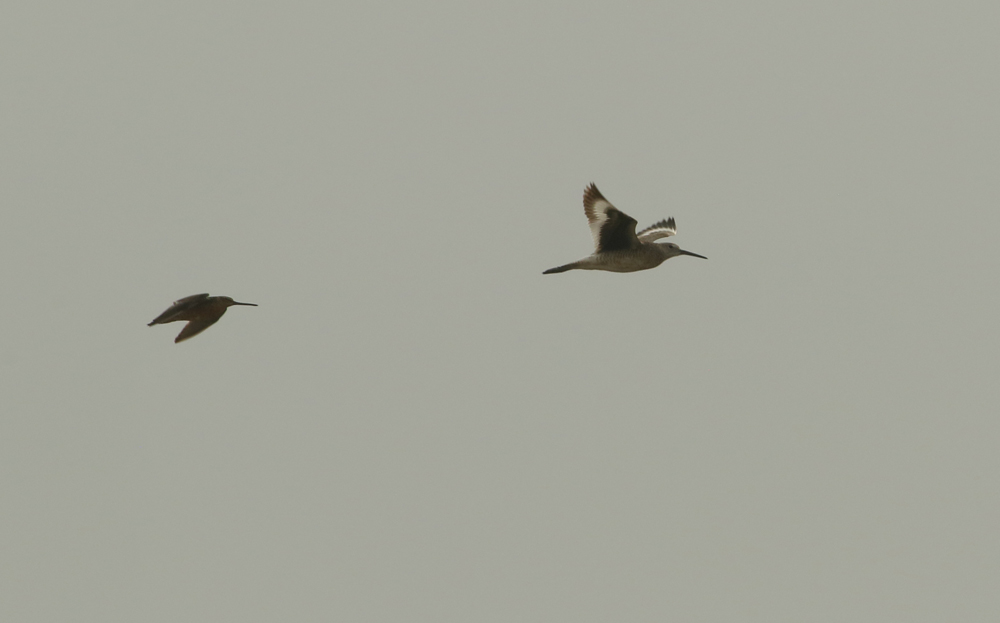
A Short-billed Dowitcher flew in to Tiscornia with a willet this morning.

Both appeared to be adults with some worn breeding feathers, and a few very worn retained feathers from the winter.

The dowitcher's bill was the same length as the willet's, though a lot skinnier!
Interesting how the birds use them in very different ways though.


I somewhat screened the birds from a beachwalker who detoured around us ... into the gulls, who flushed, taking the sandpipers with...


Tuesday, July 20, 2021

birds!

 I mean, amazing what you see when you actually go birding!

Hopefully back in the saddle, though I'm sure I've made that promise before.

Tiscornia was pleasant this morning.  A willet came in briefly in the early morning light.

After a loop up to Klock a group of avocets also flew in from the south.


They turned out to be adults still very much in breeding plumage.


As opposed to one of the motley Lesser Blackbacks that have taken a liking to the local beachgoer's refuse.


Sunday, July 11, 2021

Hide and Seek

 
Following our views of Rosita's Bunting the sun was getting pretty high and the temperature climbing.  But that didn't stop a Lesser Ground-Cuckoo from starting to call from deep in the brush.  This was a unique bird, picture a half sized roadrunner dressed for a carnival.  That being said, it had no intention of going out, being very content to stay deep in the sticky thicket.

How would you give directions for the 1 inch cylinder of visibility for others to see this thing?  You can sort of see the blue and yellow bare skin surrounding the eye.

It would walk slowly on the ground, blending in pretty much perfectly with the leaf litter.

Finally it did tee up, though this window was only about a foot wide.

It was one of the coolest birds of the trip.  This Roadside Hawk was potentially interested in seeing it as well...

though its motivation may have been a little different.

The Orange-fronted Parakeets on the other hand, they didn't give a rip!


Friday, June 25, 2021

Sunrise Rosita

We've all been there.  You see a gorgeous sunrise and try to take a pic ... and you just can't do it justice.  It's super hard for camera sensors to deal with rich cold and rich warm colors at the same time.

Rosita's Bunting is the same way.  It was one of the more striking birds I've ever seen in my life.  There aren't many birds that blend a rich blue somewhere between indigo and sky blue into magenta.  It was easy to see why they're cage bird targets and one of the birds that eBird won't give specific location data for.


The female was maybe not quite as showy as the male...


Thursday, June 3, 2021

an Oasis

 Day 4 in Mexico found us on the border of the desert state of Oaxaca and the more riparian (and tropical) state of Chiapas.  A small mountain-like escarpment shielded a waterfall from much of the sun.  A bottlebrush tree was in bloom and it attracted my eyes too quickly to remember to take a scenery shot.

Just about the first bird I saw was a Rosita's (Rose-bellied) Bunting.

We'd see some in brighter light later in the morning, but we were happy to see this one.  There were a few hummers, including Canivet's Emerald and Green-fronted Hummingbird, but it was too dark to get pics worth posting.

Streak-backed Orioles were working the bottlebrush as well.


They weren't all brilliantly colored.  One was a bird I was looking forward to, Nutting's Flycatcher.  It's one of the myarchids that all look pretty similar, but the inverse Western Kingbird tail pattern separates it from Ash-throated.

Ok back to colorful ones.  It's been a few years since I've seen White-throated Magpie-Jay.


Finally a view of a female White-lored Gnatcatcher; the gray desert gnatcatchers always surprise me after being so used to Blue-Gray.