Tuesday, February 21, 2017

courting cranes

I was hoping to spend some time at Tiscornia this morning, but steady light rain made driving cornfields more appealing (we ain't in Panama anymore!).  There were scattered groups of Canadas in a lot of places, but 2 roadside cranes drew the eye.  Initially they were just standing there, but soon they started dancing about.

I'm going to assume it's the male initiating the dance.  He stretched and strode over with his neck stretched up, bill pointed down, and wings held loosely behind his back.
It then proceeded to stretch at attention and flash its wings back and forth a few times.

You can see how these big birds don't get all their flight feathers molted in one season.  The outer two primaries are a couple years old, the next 3 fresh this spring, and the remaining 5 about a year old I suspect.

The (potential?) mate then reciprocated the wing flashing.
She (?) has molted fewer of the outer primaries and still has a few rust-stained wing coverts.

They followed that up by jumping some and dashing about flicking water with their bills.  I was enough taken aback by the scene that I couldn't decide which to track with the camera and whether to switch to video and just watched instead.

Towards the end I took a couple of the dash-about phase, though missed the focus.
Unfortunately there was no encore; they ran ostrich-like up to drier ground and resumed preening.

A flooded field on Warren Woods road held a large disparate flock of White-fronts.  They were hard to count in the stubble.
 Eventually most flushed, this next shot is the biggest group.  There were some other sub-flocks out of the frame though.

Finally a pre-dawn Glaucous Gull shot from Tiscornia last week.
I should probably make more of an effort to play around with the early light.

Monday, February 20, 2017

of Graytails and Geckos

It wasn't just manakins that Domi led us to as we circled the grounds and trails at Canopy Camp.  We found a mix of birds both common and uncommon, familiar and unfamiliar.

Anyone who has birded the tropics has seen Blue-gray Tanagers.  At one point these had been introduced to southern Florida and Peterson includes one in his main tanager plate.  I'm a little surprised they haven't been re-established as widespread as they are farther south.

Double-banded Graytail is far less cosmopolitan, limited to tall second-growth forest of the Panama-Colombian border.
We saw a pair of these quite excitable birds.  They had a very intense buzzing trill somewhat similar to a chipping sparrow, but with far more inflection and probably quadruple the rate of notes.  They moved about equally frenetically, holding their perch for a few seconds and then bugging out not just to the next branch, but to the next tree as often as not.  Domi actually showed us a nest as well, though it didn't seem to be active.  Somehow I didn't take a picture of the quite large sticky structure.

The first of many Roadside Hawks teed up appropriately alongside the road.

Yellow-breasted Flycatcher, like the graytail, is first encountered in Eastern Panama.  Unlike the graytail, its range includes most of South America.
The photo gives a somewhat fore-shortened look and this pic gives more the gestault of Yellow Tyrannulet.  In life though, its posture was much more like a typical flycatcher.

Birds weren't the only thing we saw, and while butterflies are less abundant in the dry season we were impressed by what we did see.  This is probably some kind of Heliconius.

and finally what is a Golden-headed Gecko if I remember the name right.

Friday, February 17, 2017

Ssssnapp!!

I don't think there's any sound that I more associate with the tropics than the snaps of lekking manakins.  Orange-collared Manakins seem to be fairly common in Panama and the trails around Canopy Camp were no exception.

The lek covered about a 50 foot length of trail as it elevated out of camp.  The birds were mostly on the darker side of the trail but a few would display on the brighter side as well.  Their presence was heralded by a bright 2 noted Ee-berr, Ee-berr.

  They would thrust out their little beards as they changed perches.


The subject of their displays?  The plain gray-green females that would sometimes put in an appearance.

The males would then go berzerk, snapping their wings together above their backs to produce the electric "Ssnap! Snap! Snap!" sound so unique to the neotropics as they rocketed back and forth from perch to perch.


Golden-headed Manakins were also present in smaller numbers.  These cousins of the more widely-distributed Red-capped were lifers for all of our group and don't actually make a wingsnap.  They also tended to stay a lot higher in the trees, usually about 15 or 20 feet up.  A couple of us found a few much lower as they came down to bathe in the stream as dusk fell on one of the evenings.  First is an adult male.

Next is an odd little bird which looks to be an immature male molting into more adult like plumage.

Tuesday, February 14, 2017

Snowy-bellied vs Rufous-tailed hummer ID

Looking at the pics in the Costa Rica and Panama books, a person wouldn't expect Snowy-bellied and Rufous-tailed Hummingbird to be difficult to tell apart.  That assumes of course that a person sees the gleaming white belly of the Snowy which is prominently displayed in the plates.  The problem of course is that hummingbirds are happy to turn their back to you and don't show much of their belly while nectaring at flowers.  The first time a guide called out Snowy-bellied in Costa Rica I was really confused since it looked like a Rufous-tailed to me.  Even after more experience with the bird, I still initially mis-called these Snowy-bellied's at our lunch stop on our first full day in Torti.

What would you call this bird?

Or either of these next 2?

 All have extensive brownish on their back and tails, but all are Snowy-bellied.  There's actually more dorsal brown on Snowy-bellied than this next Rufous-tailed.

The Rufous-tailed has much more intense rufous than the browner Snowy-bellied.  This next Rufous-tailed shows some extra terminal dark with the tail spread that the Snowy-bellied's don't have.
That would be hard to see in real life without the bird frozen by the camera's shutter though.

So how to separate them?  The bill is helpful.  If you look carefully, the Snowy-bellied's looks a little shorter and straighter.  It's also blacker.  Rufous-tailed at most angles shows a quite pink bill; Snowy-bellied has limited pink to the lower mandible.  First Rufous-tailed...
 ... then Snowy-bellied.

As mentioned earlier, Snowy-bellied has some pink to the underside of the bill, but any view of the underside of the bill reveals the brilliant white belly.

One last look at Snowy-bellied in reasonable light.

The first take-home is to be aware that these two birds at many angles look quite similar. The 2nd is to study Rufous-tailed closely; it's way too easy to not look carefully at this common species in the excitement of looking for new birds in the tropics.

Sunday, February 12, 2017

Panama II !!!

Well the long blogging hiatus is over.  Our group returned from Eastern Panama yesterday.  It was a great trip.  The combination of some really good birds and the best guide I've ever met (Domi Alveo) created the best experience that many of our group had ever had in the neotropics.

I'm early in the process of organizing photos and figuring out the narrative for the blog (I know I know, when has it ever had a narrative in the past?).  But there will be birds.  Lots of birds.  Camoflaged birds like a Common Potoo that materialized at our very first stop.


Striking birds like Banaquits.

Hummingbirds like this adult Black-throated Mango.


 A smattering of butterflies like this (presumed) cracker?

And viewings of the biggest baddest bird in the American Neotropics?  Yes.  Yes there will be.

Sunday, January 22, 2017

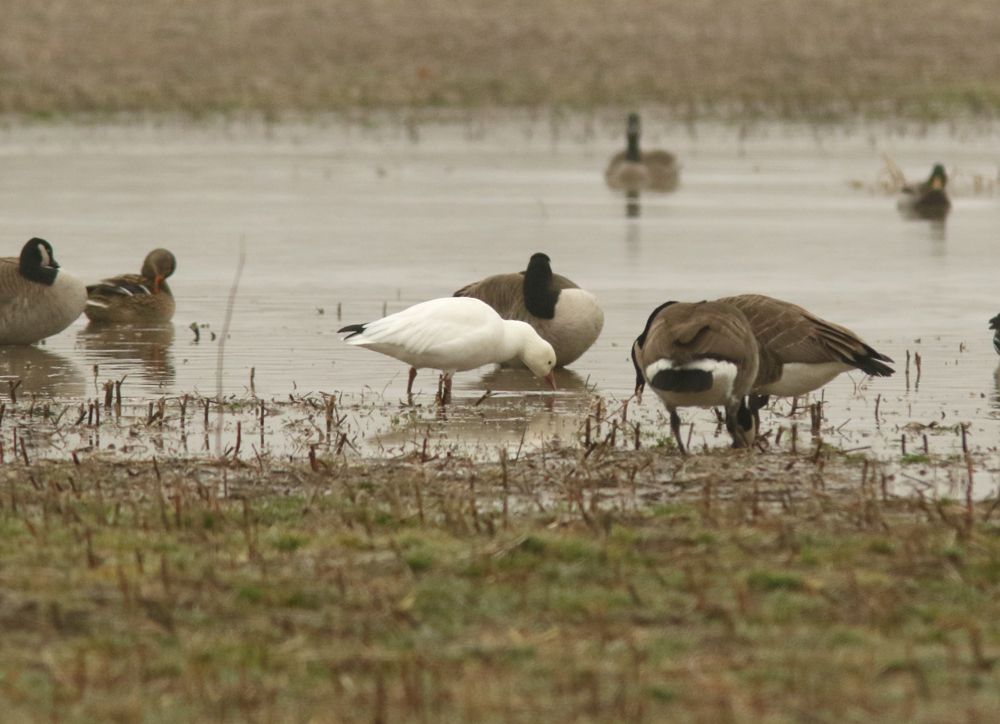
almost another Ross's Goose

I drove a bit of a central county route this afternoon.  Mary Jo and Marie were looking at a pair of White-fronted geese at the Scottdale Rd flooding when I drove up.

Four more white-fronts flew in, thought about landing, circled, and then landed across the road, drawing my eye to the Ross's that was sitting distantly close to some grapevines.

I tried a few more spots not finding much aside from Mute Swans and was heading toward home when I noticed a bunch of geese at the Anna Lane Flooding.  Not terribly surprisingly there was a Ross's type in with them as well.

It has some blue wartiness to the bill base...

but the head is less round than yesterday's Ross's Goose

And you can see that the bill base has a decent amount of curvature where it meets the face.
A curved bill base is generally accepted to indicate some Snow Goose in its not-so-recent ancestry; this bird is likely an integrade.
After finding this bird I actually drove back to Scottdale to make sure that the original Ross's was still there; it was.

Saturday, January 21, 2017

lakefront Ross's Goose

After striking out entirely on geese in the Scottdale plains where Rhoda had found a Ross's Goose earlier I did the next best thing and headed for the beach.  I wasn't expecting very much, and indeed there were few birds by the piers given the amount of boat and foot traffic on a 60 degree January day.  I was just finishing my last scan when I picked up a distant Snow-type Goose flying off the lake.  It landed off Jean Klock and I drove up to get better pics.  My camera was giving me trouble and not auto-focusing or stabilizing so I went back to phone-scoping with the scope zoomed in to 60x.

I was pretty surprised to see it also was a Ross's Goose.
 Note the round head, vertical bill base with blue wartiness, and the pale bill tip.  In the above pic shadow gives it the hint of a grin patch which was much more shadow than real.

Here's the bird with the bill not shadowing.

The bird flew after about 10 minutes and headed inland right past me.  This was total spray and pray with the shutter as I tried to manually focus through the bird and hoped a few frames would be sort of in focus.