Monday, March 13, 2017

Michigan Ivory

We rotated through Hurley hospital in the down-trodden section of Flint during residency and I still can't believe that 10 or so years later an Ivory Gull, of all things, is still hanging out maybe 2 miles away.  I've never been outside that long in that area and not heard gunshots, probably the combination of it being 17 degrees out and the insulating effects of the U of M Flint campus where it was found.  I'm going to forgo the obvious Flint water jokes (they were actually fine before they started piping in water to avoid having to purify the river water) and bask in my second ever Ivory Gull.

Is that bill sweet or what.

We drove up and arrived at 8:30 on Satuday to find out that an eagle had flushed it about 30 minutes before.  We hung out where it had been, walked a few miles up and down the river, scoped an up-stream reservoir, and eventually left after about 4 hypothermia-inducing hours.  We were 45 minutes down the highway when it was posted as being re-found.  I thought it was too late at first as I had to work at 6pm, but we did the math and figured if we turned around immediately we'd have 30 minutes with the bird.  It was a good 30 minutes.

We saw it take flight within minutes of arriving.


It then settled down in a sheltered corner next to the sidewalk and, paying no mind to the gathering herd of 2 legged caribou whose dominant vocalization appeared to be a constant low-level barrage of click, Clic-Clic-Clic, clickclickclickclickclickclick, slick-slick, CLICK shutter fire, started bathing and preening.

It would use its bill to shovel water down either shoulder.


I can't believe I cut the wingtip off the last one.  Every other frame out of 50 or so bathing series pics has the full bird.

Fluffing its feathers revealed a nice study in how birds fold their wings.

One last portrait of an incredible bird...

Wednesday, March 8, 2017

Canopy Camp Hummers

While Canopy Camp had a lot fewer hummingbird feeders than some of the mid- and high-elevation places I've stayed in the tropics, it had a few more than many low-elevation locations that have none!  It can't be easy keeping the feeders from molding immediately in that kind of heat and humidity.  I'm not sure that I really kept track of the total number of hummers we saw visiting the feeder, but there were definitely some interesting ones.

Black-throated Mangos were quite common.  I can't think of any North American birds that have a dark stripe down the ventral midline the way female and young mangos do.

This is Blue-chested Hummingbird.
 In the past I'd only seen this bird perched high up in Costa Rican trees and had never seen one down low.

The somewhat similar Sapphire-throated Hummingbird doesn't occur any farther north than Eastern Panama.  The notched tail isn't visible in this pic.
I don't think I've ever seen a hummingbird with a bill that thick.  I never thought a hummingbird would remind me of a Willet, but if that's possible then this is the bird to do it.  We only saw a couple and only right in camp.

Blue-throated Goldentail is another bird I'd only seen in Costa Rican treetops.
 You wouldn't know it from the first pic, but this is another bird that you can blow off as a Rufous-tailed with just a glance.
You can see why with it perched given the bright pink bill and rufous rump.  The bill is shorter on the goldentail though, and obviously there's the blue throat.  The perched pic is a digi-scoped one Rhoda took, full-frame digi-scoping can still give superior results to cropped in SLR pics.  There'll be more digi-scoped pics in future posts.

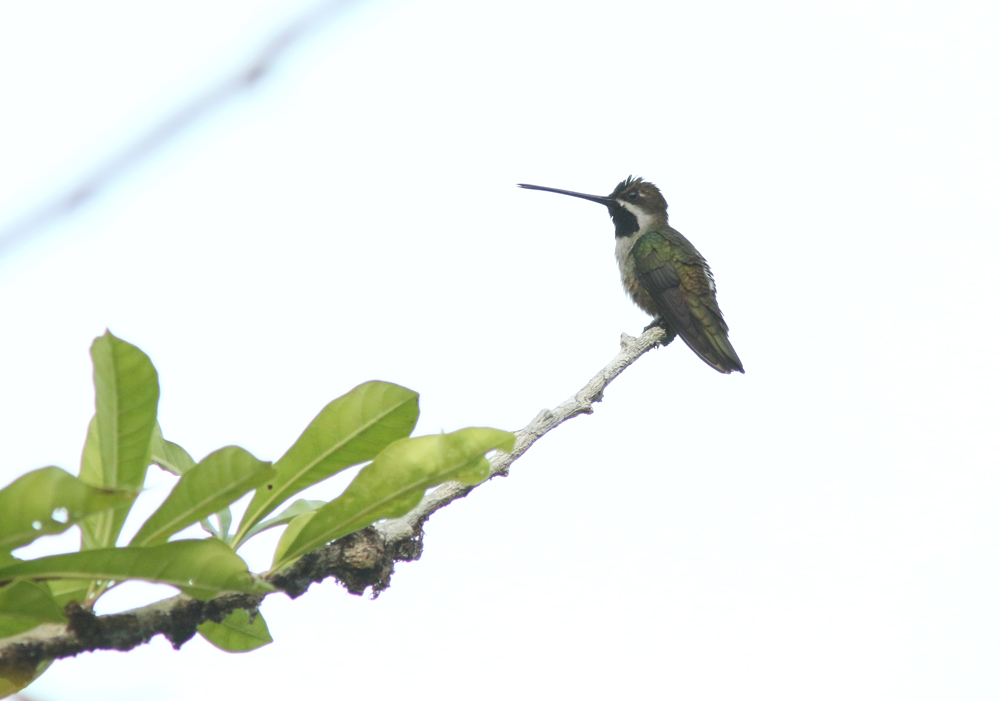
Finally only the 2nd time that I've seen Long-billed Starthroat
It wasn't common enough to get any full-frame pics, but was fun to see nonetheless.

Saturday, March 4, 2017

Kestrel vs Savannah Hawk

As we left the teak farm our driver spotted another of our targets, a Savannah Hawk.  I believe this is a fairly widespread species in South America, but was a new genus (Buteogallus) for all of us.  It acted like a Buteo but was much longer legged (and maybe smaller headed?) with much differently shaped wings and tail.

It was teed up atop a snag Redtail-like.  See anything over its right shoulder?  It didn't.


The hawk is tracking the kestrel with its eyes.

the kestrel peeled off pretty quickly though...

While the Savannah Hawk curled back to a more distant snag.

Thursday, March 2, 2017

Flycatcher fest

Flycatchers might be the defining bird of our neotropics.  My understanding is they're found only in the New World and include the most number of species of any family.  So maybe it wasn't terribly surprising that on our first teak farm walk we found a bunch of little ones right next to each other.

First up Fork-tailed.  While some of these are among the harder ID problems out there this one can be confused with only 3 birds, Scissor-tailed, escaped Whydahs, and birds with garbage trailing from their legs.
 This one has no garbage trailing from its legs.  I guess that means it's a Fork-tail.

I have one bad pic of the next 2 birds in the same frame as the Forktail that I didn't include.  Here's a medium sized flycatcher with a yellow-belly and a titmouse-like crest.
 It's a Yellow-bellied Elaenia.  Elaenia seems to be a catch-all description of a bunch of birds.  Some of the sub-groups are extremely difficult to separate.  The confusion species for this one is Lesser Elaenia whose belly is less yellow and whose crest is less impressive (it also stops in central Panama).

One of the kiskadee class...
It's medium sized, smaller than Kiskadee or Boat-billed.  You can get a sense of the rusty flight feathers of this Rusty-margined Flycatcher, but they're not super obvious.  It's song, a weak insipid weeeeahh, is a pretty common one in Panama and worth learning.

This is a harder one (2 pics)

With the suggestion of a weird-shaped short but slightly down-drooped bill and a weak crest, this bird is Southern Beardless Tyrannulet.  Less seems to be the operative description of this bird, less down-drooped than a Bentbill, less crested than Yellow-bellied Eleania, less facial patterning than a Sooty-headed Tyrannulet, etc.

Finally another subtle species whose high thin "few-breeooh" is another song worth learning.
 Very short stubby bill, somewhat generic grayish flycatcher face, has wingbars (just barely visible in this pic), this little bird is Yellow-crowned Tyrannulet.  Tyrannulet is an even worse catch-all name for small generally very short-billed flycatchers that don't seem all that related to each other.  Of course the alternative is to make the genus name the common name.  And while that may make it easier to understand the relationships between some of the birds it definitely won't make it easy to roll the name of a somewhat unfamiliar bird off your tongue in the field as anyone looking at a bush-tanager, errrrrrr, chlorospingus will tell you.  And there's more than one bush-tanager, errrrrr, chlorospingus in Ecuador.  Better get practicing people, better get practicing...

Monday, February 27, 2017

teak farm birding, part I

Apparently farming teak trees is a fairly big industry in eastern Panama.  The lumber companies lease pasture land from the local farmers and plant rows of teak which are ready for harvest after about 20 years.  This one provided access to a variety of patchy edge habitats around the teak and at other times in wilder overgrown sections.

Black-tailed Trogon was on my want list last year; I was surprised we didn't see one, though in Eastern Panama they were quite common.
These birds are quite similar to the more widespread Slaty-tailed Trogon.  Black-tailed has a heavier (yellow instead of reddish) bill, a red eyering, and a narrow band of white separating the green breast from the red belly.

Lathe spotted another of the Eastern Panama specialties, Barred Puffbird.
 Domi said they're known to lump small birds in with large insects and eat one just as happily as another.

Another Chestnut-headed Oropendola.  They were common in the camp, but tended to be atop trees.

A look at a pair of Cinnamon Woodpeckers.

While looking at a surprising variety of small flycatchers clustered in one small area (more next post) Domi called out Great Green Macaws screeching.  The ground was open enough that we were able to see a half dozen fly steadily past.

We headed back to camp and our driver stopped for a Great Potoo.  The bird was hawk-sized.


I assume that these bizarre birds also eat bats like their smaller cousins.

Saturday, February 25, 2017

a night walk

Early on in the trip we did a post dinner walk down the entrance road to Canopy Camp.  Domi called in a Tropical Screech-owl fairly quickly.  This looks to be a gray morph, many of us had previously seen the much less common rufous morph in Costa Rica.
It was more similar to our Eastern than I expected.  We heard Black-and-white and Crested Owls though I'm not sure we ever completely settled whether it was Black-and-white or Mottled that would give single hoots that we heard most nights in camp.  The Black-and-white started coming it to his speaker but pretty quickly lost interest.

Looking for eyeshine revealed a couple of Kinkajous, the first of 3 lifer mammals.

I'd never even heard of the next two.  First is a Central American Wooly-opposum.

And finally a pair of Night Monkeys that were considerably higher up in a cecropia than the other creatures.

Thursday, February 23, 2017

El Real

Spot-breasted Woodpecker is another bird that's probably reasonably findable in South America, but for Central America can only be found in Panama's Darien, and not in a ton of spots either.  I was happy to hear that Domi had a spot for this bird, traditionally found around El Real.  We didn't really have to wait very long either, the bird teed up pretty quickly in an isolated tree allowing distant but clear views.  We moved down the road to see what else could be found and one ended up landing right above my head.


This has to be one of the prettier woodpeckers I've seen, combining an (inverse) acorn woodpecker face with the gold of a flicker (only with the saturation of the gold boosted way past what any of our birds would show).

Domi picked up a Striped Cuckoo by ear.  It was actually one of the songs I'd learned prior to going down, but it didn't stand out until he pointed it out.

We soon moved a few miles down the road, picking up my lifer Zone-tailed Hawk in the process.  I checked my settings out on one of the abundant Rusty-margined Flycatchers...

... and was rewarded for having them zeroed in when another target, Black Oropendola flew by.
For me oropendolas were more difficult to identify on this trip than perhaps they should have been.  Their names aren't awesome since both Crested and Chestnut-headed have wispy crests and both birds can look quite brown overall.  Black Oropendola is the only local one that has the harlequin face shared with the Montezuma Oropendolas that are fairly widespread in the rest of Central America, so it was nice to have at least one that was easy to ID.