Sunday, February 16, 2014

Tanager framefill for lunch

An obvious advantage of birding with a group is that more eyes spot more birds (with diminishing returns certainly).  The advantage of birding by yourself is the birds have a harder time spotting you.  When I'm birding by myself I tend to move fairly slowly (which used to drive Ginger nuts when she would walk trails with me), but it paid off at lunchtime in Savegre when I found a feeding flock, worked my way in front of it, and let the birds come to me.

As per usual, Sooty-capped Bush-tanagers dominated the flock


Their cousin the (at least in the highlands somewhat less-) Common Bush-tanager joined them
As did two of the showier highland birds, Silver-throated and Spangle-cheeked Tanager


No mixed flock at this elevation would lack a Collared Redstart
A Flame-throated Warbler tried to slip by at a higher level ...
and a Mountain Elaenia somewhat lower, though I'm not totally sure it was part of the group.

This Ruddy-capped Nightengale-thrush was on the way back to the cabins, appearing at my feet

Saturday, February 15, 2014

The Los Robles trail

We started our full day in the highlands by heading up into the climax oak forest along the Los Robles trail though the first good bird of the day was a female Long-tailed Silky from the back deck of the lodge
 They were easier to find this year than last.

 We took a small 4x4 truck-like vehicle up the steep ridge to get to the trail.  We started finding birds basically as soon as we got out, first a collared trogon (better pics later though) and a couple Golden-bellied Flycatchers up in the canopy.  At one point I was lying on my back shooting so I wouldn't be trying to crane the camera straight up.

A lot of the tropical birds can be found in mixed feeding flocks, find a flock, find the birds.  The dominant species in the high-oak forest in the mixed flocks were Ruddy Treerunners and the surprisingly difficult to photograph Black-cheeked Warbler

A Streak-breasted Treehunter worked about the edges of one little group, a bird we heard last year but that I'd never seen.  Of course it stayed tucked in pretty well and when it came out it was directly backlit in a strong sunbeam
It was the size of a small jay but fed like a chickadee (and was nearly as vocal as either).

Other birds were more soliatary (like an aptly named Black-faced Solitaire).  The Solitaire's song is well worth pulling up in xeno-cantu, it sings a series of harmonics somewhat on the pitch of the climactic note of a Hermit Thrush song
Other flycatchers included Dark Pewee, Black-capped Flycatcher, and this Yellowish Flycatcher, a bright empid with a Cordy Fly eye teardrop.
We heard a chlorophonia up high but couldn't locate it.  We worked pretty hard for Flame-throated Warbler, settling for more warbler-neck views looking more or less straight up.

Butterflies were coming out as we were on our way down, Gulf Fritillaries were pretty common

 I'm not quite sure what this one is though.

Friday, February 14, 2014

Flame-colored Photoshoot

The feeders at Miriam's Restaurante would be famous if they were in SE Arizona, in CR they're relatively more anonymous.  The birds are very habituated to people on the sidewalk just feet away from the feeder which leads to some fun photo-ops.  Flame-colored Tanagers are common.

It says something about Costa Rican birds that when you think of the 10 (or 20? more?) most impressive species this one doesn't even come to mind.

It should though.  They're so bright that the camera sensor has trouble dealing with them in full sun.  It's one thing to blow the whites out and overexpose a small area of the bird that's white, but when you're blowing vermillion out that's something else entirely...

Exposure's a little easier in the shade


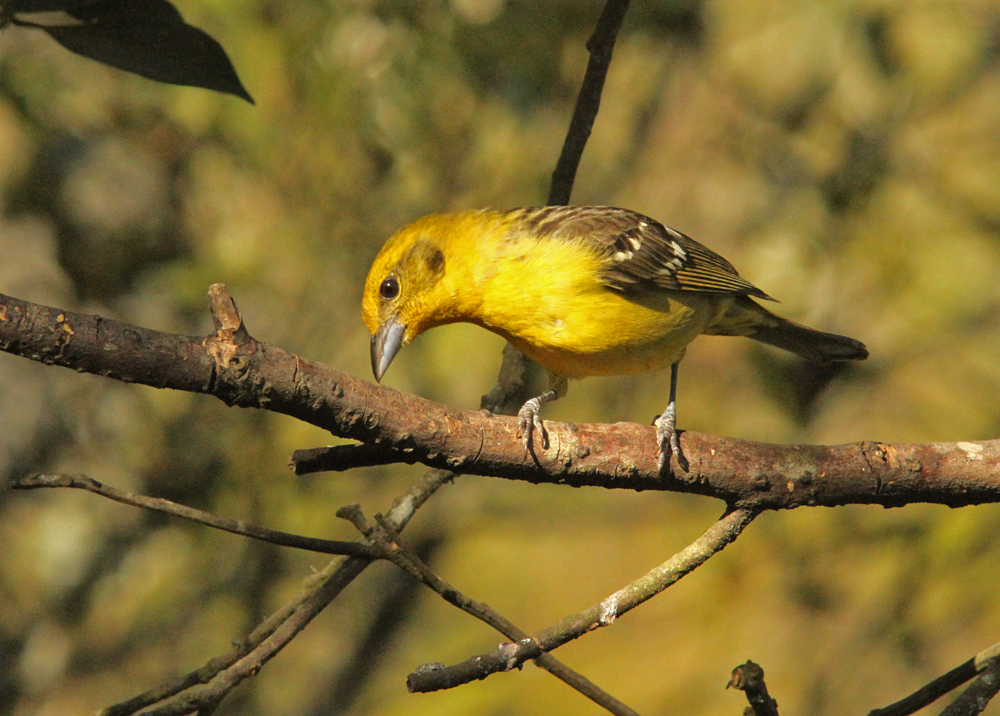
Mrs. Flame always reminds me of pics of Yellow Grosbeaks
 You can see the two notches on the side of the bill, the trigger for its Latin specific name of bidentata if you look carefully.

What's the opposite of a Flame-colored Tanager?  Definitely not a Rufous-browed Peppershrike which teased us for a while by singing constantly (and invisibly) downslope before coming briefly into view.

Large-footed Finch gets us a little closer (this one is doing some Valentine's advertising to a mate)

Sooty thrush gets us closer, but is still an attractive bird.

The opposite of a Flame-colored Tanager?  I'd say, drumroll please, the Mountain Robin
Take it in, in all of its mud-brown hook-billed glory.

Wednesday, February 12, 2014

Hummingbirds in the mist

This may border on sacrilege, but I think that Resplendent Quetzal is only the 2nd coolest bird at Paraiso Quetzal.  Their hummingbird feeders attract the first, at some times of the year clouds of them, this time only one (most are sitting on nest).  The bird? Fiery-throated Hummingbird.

 In a lot of lighting situations they look all dark, blackish.  But they have a pretty full rainbow iridescence if you catch them just right...
 

Last year there were probably a hundred Fiery-throateds, but fortunately the one remaining bird was fairly pugnacious and chased away as many of the Magnificents and Green Violet-ears as it could.  The female Magnificents' enormous bill gave it some pause though

("Hmmmm.  Yours is bigger than mine")

The Magnificent hummingbirds were also pretty impressive in the right light.


The Magnificents more than others frequently would collect a decent amount of pollen and sometimes even look yellowish.

 
Same with this Violet-ear.

If you really want to blow through shutter exposures try shooting flying hummingbirds.
The indirect lighting in the mistiness made it easier to keep the exposures even and not have some sections of the bird blown out and others too dark, but made it harder to shoot moving birds.  A little bit of sun helped increase the shutter speed on the Magnificent.  It was back a lot slower for the Fiery-throat though.

Tuesday, February 11, 2014

Quetzals in a cow pasture

One of the reasons I wanted to go back to Costa Rica was to get a better Quetzal pic, last year's was distant and in the shade.  When we got to Paraiso Quetzal we were told that a National Geo film crew had seen 30 of them that morning.  I'm not sure I believe that, but, we had pretty good hopes that we'd find one.  We were led down a winding two-track with a fair amount of up-and-down elevation change ending not in a scenic mountain grove, not in a picturesque grove with a mountain stream, but to a cow pasture.  A cow pasture with fruiting avocado trees.

One of the guides fairly quickly spotted a tucked in female across the field and waved us another 200 yards or so.  There was a male present as well.


A "tail"less mail (the long feathers are actually uppertail coverts) flew past and this bird flew out pretty quickly as well.


The group honestly would have been satisfied, but our guides were pretty confident they could find more (and after shushing us, ok, a couple times) we headed a few trees farther, and found a perched female and then her male as well.

We had a walk-away view.

One last view of the avocado fruits that were drawing them.

Monday, February 10, 2014

Another Ochraceous Pewee

Both years our first highland stop has been at Paraiso de Quetzal, a lodge with a set of cabanas and a restaurant with a famous hummingbird feeder set-up.  There area also trails from which a person can encounter most of the highland endemics found only on Eastern Costa Rica and Western Panama.  It's one of my favorite places to bird, and it did not disappoint this year either.

Black-billed Nightengale-thrushes are common highland birds.  Note the (for once appropriately named) bill, the similar ruddy-capped (coming soon to a post near you) had a bicolored bill

A Tufted Flycatcher teed up on an overhead power line as we walked out to a field where quetzals had been feeding earlier in the morning.
Our guide Vernon was fairly excited about the near side-to-side comparison with a very hard-to-find highland endemic that flew in 20 yards farther down the line, an Ochraceous Pewee
The Ochraceous is heavier-bodied, heavier-headed, slightly less crested, and less warmly colored than the similar Tufted Fly.  Last  year our guides worked and worked for an Ochraceous on the Los Robles trail that they could hear calling up in the canopy before we finally got scope looks, this year it came straight to us.

The Costa Rican version of Hairy Woodpecker was also very ochraceous (and with a lot less white in the wings).  My understanding is that they have a continuous clinal transition, but skipping south 2000 miles made a big difference in appearance.

Each of the volcanoes in Costa Rica has Volcano Hummingbirds with a slightly different throat color.  In the Talamanca highlands it's a dull lavender.  When they were all split this one was called "Heliotrope-throated."

Finally a lifer, a Yellow-billed Cacique, a loose cousin to orioles but one that skulks in the underbrush
Don't ask me to pronounce it though.

Oh and the quetzals?  They might be deserving of their own post...