Wednesday, August 28, 2019

Wild Sumaco Tanagers

Wild Sumaco was by far my favorite place on the last Ecuador trip.  A month (I've been bad) ago I had a few posts about bird coming in to their buglights.  After leaving the buglights we walked the road seeing what we could see and then set up on an open hillside hoping for a mixed flock.  The mixed flock never really materialized but a Black-mandibled Toucan teed up for a bit.


Last year we had good looks at Glistening-green Tanager.  This year we saw the eastern slope cousin, the Orange-eared Tanager

Next up are a couple of roadside birds. The Speckled-class tanagers are birds very different from any we have, as finely streaked as many of our little brown sparrows, but blue and yellow and green instead.  First up is a Spotted Tanager


And this similar species is Yellow-bellied Tanager


Saturday, August 17, 2019

Red Knot in the sunrise

There's been a knot at New Buff the last couple days, I was there at sun-up this morning.  It was feeding actively aside from when killdeer or geese would fly by freezing it up from time to time.

The bird is a juvenile as evidenced by the small fresh scapulars.  This is the reddest I've seen a juvie, though it may also be the earliest I've had this species in fall and simply have fresher plumage.


There's still some algae left from whatever the last prey item was.

There were a handful of semi's around, but this Least zipped past the knot for a fun size comparison.

Honestly the water drops from the little wavelet hitting the algae distract more than they add interest to the next one.

One last pic from just before the sun rose.
Hopefully Baird's will be next!

Friday, August 2, 2019

Singing to the end

I hadn't checked on the Bell's in a while so I wandered by this morning.

It's still singing away.  It sounded a little quieter to me, not sure if that was real, or if it's starting to lose some of its interest.  The rate of songs sounded unchanged to me.

It's already molting as evidenced by the swallow-tail.  It's surprising to me that it's still singing and trying to attract a mate while its feathers prep for migration, but then again if anything will sing till the end it'd be a vireo.

And proof that the summer if flying by, we've moved right past clubtail season (July) and into the Darners...
My best guess is that this is Shadow Darner.  I tried to get a pic of the very tip of the abdomen to be for sure, but forgot whether you want a top or side view.  (I went for top but should have gone for side).  It flushed (and then was nearly eaten by one of the local kingbirds), oops.

Friday, July 26, 2019

Trogons in the buglites

One last series of pics from the buglites at San Isidro (how did a couple weeks elapse between posts???).  But enough of subtle grays and browns, why don't we transition to Christmas colors?

A pair of Collared Trogons came in for breakfast as the light finally started to shade into day (though they're still super grainy)...


I've never managed a pic of a trogon's vermiculated wing coverts that I was satisfied with

The female is less colorful, but in some ways the teardrop eyering makes her more dramatic

Mmmm, moths...


Tuesday, July 9, 2019

BELL'S VIREO

I've listened for this bird (and occasionally trolled with tapes) A LOT in Berrien County.  Last spring in Texas I listened (and looked) at them.  There were a lot of birds on that trip that were easy to find if you're where the bird is supposed to be (scissor-tailed fly, Bell's, chat, Blue Grosbeak, etc) and it was re-assuring that the sounds popped out.  And pop out it did here in Berrien.  The song was soft initially but eventually the bird came into view, heavier billed than a Warbling, yellower below, and  wing barred.  It was satifying.  The pics are so-so, the bird isn't along a trail.  The territory is on golf course property in an area not really open to the public so a person can't get that close.  Fortunately it's right next to the RAC parking lot so is audible and at times distantly visible.

The pics are cropped pretty heavily.  I think this is just the 2nd county record since 2000 in eBird, and Berrien has more records historically than anywhere else in Michigan, though the MBRC searchable database is down; I'm not sure how many official records there are.


In other news, I may have one last (female) slot open for next February's trip to Ecaudor. If you're interested in seeing hoatzins, antbirds, and parrot/macaw clay licks in a small group of 8 people let me know if I can send you the full details!  (matthysell@comcast.net)

Thursday, July 4, 2019

more buglite bliss

Bliss might be too strong a word, but there were a lot of cool birds.

The biglite area remained DARK.  It was probably an hour before the sun rose, but as it did clouds thickened, humidity turned to sprinkles and sprinkles into rain.  We perservered, and the rain started to fade away and some more birds worked their way in.

This is Ornate Flycatcher, a bird we saw a few times last year.

I hadn't even learned this next one's name however.
 It turned out to be Peruvian Warbling Antbird; the name is longer than the bird.

Plain Antvireo looked a little different than the Central American forms but I'm not sure I could say why

White-breasted Wood-wren was pretty identical to its Central American cousins though.

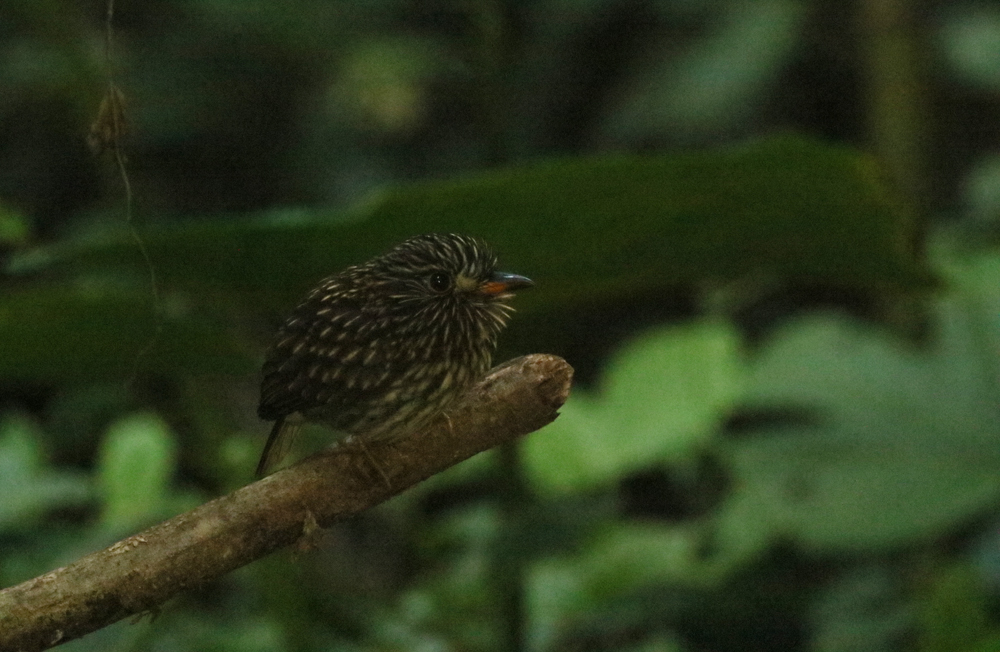
Finally a White-chested Puffbird, a bird whose posture can give lie to its name.


Sunday, June 30, 2019

Best buglites ever

A lot of lodges in the neotropics use white or blacklights behind sheets to attract moths, and therefore birds, that otherwise would be very difficult to see well.  The bug lights at Wild Sumaco were the nicest set-up I've seen.  They sheet (and light) were out of sight below eye level of the blind.  This meant that our eyes were able to adjust to the dark while light was being cast upon the birds.

There was nice diversity at their light, (and we would see none of these birds elsewhere in the woods), but Black-faced Antbird was the most prominent species.


 Here's the female.

Black-billed Treehunter made several appearances.

There are several red-eyed antbirds classed as Fire-eyes, this is White-backed Fire-eye (the white is a tiny spot right where the black of the nape meets the brown of the back).

Slate-throated Redstart added a bit of color.

And finally a personal favorite, Buff-fronted Foliage-gleaner.