Showing posts with label Redpoll ID. Show all posts

Wednesday, February 1, 2012

Grading Hoaries

I was kind of figuring that with the snow melted that redpolls wouldn't really come into feeders that much this year so I was pretty surprised when the 2nd redpoll that flew into the Sarett feeders the other day was this Hoary. A few years ago there were a couple hundred redpolls using the feeders and while I was able to pull out a Greenland/Greater Redpoll that year I never saw a Hoary. This one was pretty easy, the 2nd whitest female Hoary I've ever seen.
Here's another view of the nasal feathering giving it a stub-billed appearance as well as the well-feathered legs which may be a supporting character for Hoaries. The bird is very frosty and has a lot of white coming in along the sides of the scapulars. It has one line of fairly well- defined flank streaking with a couple other less well-defined streaks as well.
The rump was white.
As was the undertail; this bird had the whitest undertail coverts I've ever seen (though was difficult to capture shooting through the glass at Sarett).
Here's the (presumably adult female) Hoary with a male Common.
For a little while the quite white Hoary was joined by a second Hoary (the bird on the left)
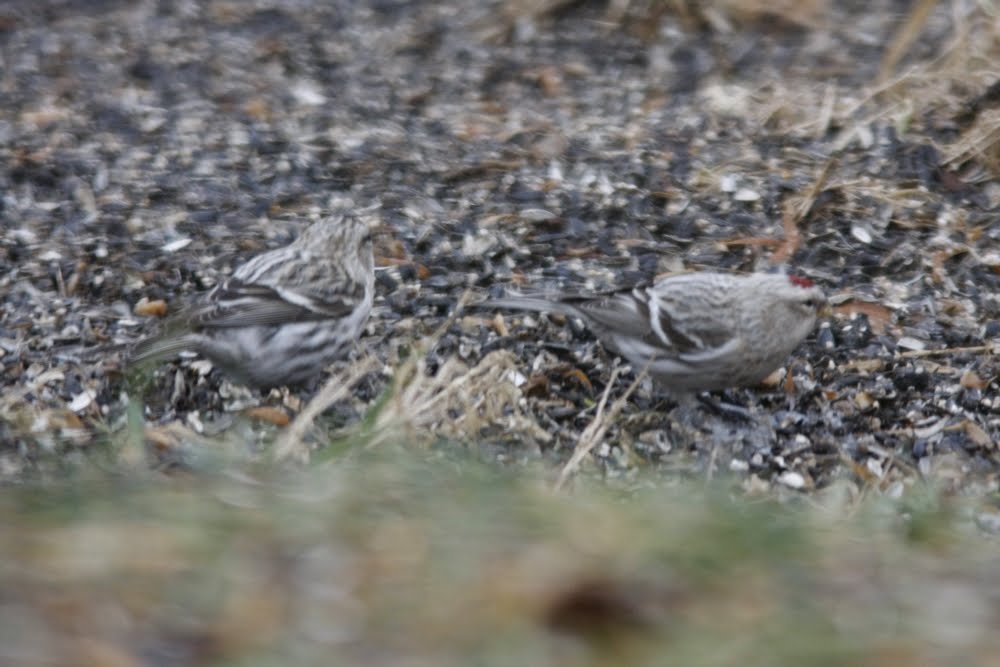
The second bird was in that harder to judge probable first winter plumage. It had somewhat more prominent flank streaking, but still very white in the ground color. It had some warm creamy tones in the face which are also indicative of a first winter bird.
It had one streak in the undertail, I never got a photo of the rump aside from the side view below.

Here's the adult Hoary having a go at the youngster (check out her pantaloons). They seemed to associate with each other when the 2nd bird was present.
Per the Sibley grading system for redpolls, I'd give the whiter bird a 6 for undertail and rump and a 4 or 5 for side streaking for a grade of 16 or 17. The other bird I would give a 5 for undertail streaking, and 4 for flank and a 4 or 5 for a glimpse at the rump for a total of 13 or 14. The caveat is that the grading system was developed more to look at variation than to discriminate species.

Monday, February 16, 2009

Red, white and blue in February

You don't really expect that much in the way of bright color in mid-February, but today was the exception.

It started with Andre finding a (presumeably adult or near-adult female) hoary redpoll coming in to his feeders.  This bird is definitely a notch whiter than Tim's bird a few weeks ago.  It seemed to me to be just barely a size larger than the commons it was hanging out with.

Note the stub of a bill, whitish ground color and the very nicely whitening last scapulars:

The bird held its wings closed tightly and I honestly never had a terrific view of the rump end-on, this was my best view of it from the side.   It appears pretty white, I think that the streaking that's visible is pretty lateral.
Here's some views of the undertail coverts.  While on the ground we had to strain to see the very narrow central vein to the final feather.  On its single trip up to a thistle sock (when it landed atop the feeder it drew oohs and aahs it was so white) there's a subtle tint to the central vane of the feathers made invisible on the ground by the bloom of the flank feathers.

The redpoll wasn't the only bird attracted to the feeder set-ups.  A few pine siskins, a female purple finch, a calling red-shouldered hawk, and this very cooperative bluebird (whose initial song fragments my winter-rusted ears recognized as being something different and familiar but didn't click in until I actually saw the bird).

Finally some of the Sarett crew who twitched the redpoll brought news of a new (and fresh) crossbill spot so Tim and I headed over to Shawnee and Cleveland to pick them up for Baroda Twp.  They were pretty quiet, we didn't hear them on our first walk pass the line of conifers.
So, for the day I tallied a handful of Oronoko Twp birds, scored my best piccies of bluebird and WW crossbills, and saw my 4th-(give or take)-ever Hoary Redpoll.  Not bad for mid-February.

Sunday, January 25, 2009

A hoary-type redpoll

At the risk of becoming the patron blogger of hopeless bird ID, here's an issue that David Sibley addressed with no less than 13 posts last winter.  Clearly there's much to be learned.  He made the point that blowing off anything but the palest of pale redpolls as a common was just as significant an error as overcalling pale commons hoaries (though both obviously are errors).

Tim called me while I was fruitlessly searching for WW crossbills in the central part of the county that he had another hoary redpoll at his feeders (he had one at his feeders about 5 years ago that I twitched while visiting Ginger's family around Christmastime).  He noted that this one was darker than the first one.  Here's today's bird:
Here's a zoom of the first photo.  I admit I didn't buy it as a hoary at first.  After studying it for a while though, it became clear that it was definitely frostier in overall color than the other redpolls.  Some of the male common redpolls had less streaked sides, but none of the females did.  Its bill is on the short end of the redpoll spectrum and the culmen does look concave in this pic.  This pic also shows some paler edges of the last scapulars; this was more visible in some of the bird's poses in the field than others.

The amount of black in the face does seem reduced, though this also varied based on pose.  You almost get the sense in the next picture of a little pinkish about the malar region.  I don't think this has much significance for sexing it; both Sibley and Pyle only mention the breast and rump as areas to look for pink.  Tim thought that the bird's flank streaking was more organized than the (male) common redpolls which demonstrated similar degrees of streaking.  I was inclined to agree.
Here's the best view of the rear, of the rump and undertail pattern:
The ground color of the rump is white.  There is dark central streaking to the last uppertail coverts, but only minimal black streaking to the rump itself.  The last undertail covert had a black central streak of medium width.  We really scrutinized the bird for other undertail streaks and had the sense that there might be a very thin one on the left, but were never certain.

For comparison here's an old photo of a female Common Redpoll:
Note the longer bill.  The last undertail covert has a wider shaft streak than our bird (you'll have to take my word for it, due to the angle of the photos that's not really apparent from the pics).  Obviously the undertail streaking is variable from bird to bird, comparison of just 2 photos in this regard is fairly meaningless.  Also I vaguely remember in one of Sibley's redpoll post he made the interesting observation that the degree of undertail streaking in common's doesn't really correlate with how dark or light the bird is overall.

Here's two pics of the adult female Hoary from Tim's house 5 years ago:

Its tail had a thin central shaft streak on the central UT covert and a very faint central shaft on the next feather to the left.

Finally here's a male Hoary from the feeding station in the Dunbar Forest in the eastern UP, one of the sort-of reliable places to look for them (I was REALLY cold, I didn't realize the soles were coming off my boots and when I squatted down to try to search for the birds with my scope I was basically in -10 degree weather with the bottom of my feet just in socks.  It was difficult to take pics as hard as I was shivering):

I think our bird is probably a first year female hoary (though fortunately I don't have to worry too much since I'm not doing a big year.  Really).  This is the age you would "expect" in a non-irruption year.  Using the scoring system on Sibley's site from the Jan 5, 2008 post, I would score today's bird an 11 or a 12 (the one from 5 years ago is probably a 13-14).  An 11 or higher would put a female bird in the Hoary range, with a couple caveats that birds get paler as the winter progresses and that the scale isn't validated to confirm species ID.  

Random redpoll rat fact I noticed while sketching birds at my feeders:  redpolls have much longer primary extension than goldfinches, having P9-P3 typically visible whereas in goldfinches it's usually just P9-P5.  I'm not sure if that's because redpolls have longer primaries or shorter secondaries, or both.  I seem to remember in longspurs that the more migratory ones (Smith's and Lapland) have more visible primaries than the other 2 since their wings are longer to allow for their longer migration.  Sibley mentioned a study that documented a redpoll banded in Michigan being recovered in Siberia (!) so clearly we're dealing with some long distance migrants.  I guess we can also conclude that Siberia is at least one place colder than Michigan in the winter.